
Key Takeaways
- Generative Engine Optimization (GEO) means making your content easy for AI tools like ChatGPT, Perplexity, Gemini, and Google AI Overviews to find, trust, and cite.
- GEO sits on top of SEO. Google says optimizing for AI search is still SEO, so weak SEO basics will cap your GEO results.
- Princeton researchers found that adding sources, expert quotes, and statistics can lift visibility in AI answers by up to 40% in tests.
- Several popular “GEO hacks” do nothing for Google, including llms.txt files and chopping content into tiny chunks.
- You can measure GEO for free with Search Console, GA4, and a fixed set of test prompts.
Search doesn’t end at ten blue links anymore. Someone asks ChatGPT for the best option, reads one answer, and moves on. If your brand isn’t in that answer, that buyer never sees you.
That’s the gap Generative Engine Optimization fills. This generative engine optimization guide covers what GEO is, how it works, how it compares with SEO, and the GEO marketing strategy I use with clients. I’ve also marked what the evidence supports and what’s still hype.
What Is Generative Engine Optimization (GEO)?
Generative Engine Optimization (GEO) is the practice of shaping your content, brand signals, and website so AI search tools can find your pages, trust them, and cite them in generated answers. Those tools include ChatGPT, Perplexity, Gemini, Claude, Copilot, Google AI Overviews, and Google AI Mode.
The term comes from a 2023 research paper by Aggarwal and colleagues, later presented at the ACM KDD 2024 conference.
In classic search, you compete for a spot in a list. In generative search, you compete to be one of the few sources the AI names. The game is different, but the foundation is familiar. If you’re new to that foundation, start with my guide on what SEO is.
How Does GEO Work?
Generative engines don’t answer from memory alone. Many of them search first, read what they find, and then write the answer.
Google calls this retrieval-augmented generation (RAG). Its AI features pull relevant pages from the Search index, then generate a response based on them. Google also uses query fan-out, where the model splits one question into several related searches. In Google’s own example, a question about fixing a weedy lawn also triggers searches for herbicides, chemical-free removal, and prevention.
Here’s the working model I use. It’s my own framing, not an official Google framework:
- Retrieval: Can the engine reach and index your page?
- Selection: Is your page the clearest, most credible answer to one of those sub-questions?
- Synthesis: Can the model lift a clean, accurate statement from your page?
Most sites stop at step one. GEO mostly happens in steps two and three.
Here’s what that looks like in practice. In the example below, the prompt asks for one definitive answer on the best VPN. The AI names a single brand and backs it with citations from review sites and a YouTube video, not the brand’s own website.
Look at the follow-up suggestions too. One already points to a rival brand. That’s why a single result never tells the full story.
One hard requirement: to appear in Google’s AI features, a page must be indexed and eligible to show with a snippet.
GEO vs SEO: What Is the Difference?
The short answer: SEO gets your page ranked, GEO gets your information cited. They share most of their foundation.
| SEO | GEO | |
|---|---|---|
| Goal | Rank pages in search results | Get cited or mentioned in AI answers |
| Success looks like | Rankings, clicks | Citations, brand mentions, AI referral visits |
| What you optimize | Whole pages | Passages, claims, and your brand entity |
| Core signals | Relevance, links, technical health, content quality | The same, plus clear answers, original data, third-party mentions |
| Main tools | Search Console, rank trackers | Search Console AI report, GA4, prompt tracking |
The overlap is bigger than the gap. Google states that from its perspective, optimizing for generative AI search is optimizing for the search experience, and so it is still SEO. My full breakdown is in SEO vs AEO vs GEO.
Is GEO the same as AEO?
In practice, mostly yes. AEO (Answer Engine Optimization) started with featured snippets and voice answers. GEO focuses on generative AI responses. Most teams run both as one workflow. I explain AEO in What Is Answer Engine Optimization.
Does Generative Engine Optimization Actually Work?
There’s real evidence, with limits. The Princeton study reported that GEO methods can boost visibility in generative engine responses by up to 40%, and that results vary across domains.
arXiv
The three strongest methods were adding citations, expert quotations, and statistics. Keyword stuffing, the old SEO habit, didn’t deliver meaningful gains.
Blck Alpaca
Read that number carefully. “Up to 40%” is a best case, not an average. It came from a lab benchmark built in 2023, and AI engines have changed since. Treat it as a direction, not a promise.
Why Does GEO Matter in 2026?
Because the click is moving. An Ahrefs study of 300,000 keywords found that when an AI Overview appeared, the top result lost about 58% of its clicks, position two lost about half, and even position ten dropped nearly 20%. An earlier Ahrefs study measured a 34.5% drop for position one, so the effect appears to be growing. You can read the full Ahrefs findings here.
Two caveats. These figures cover informational keywords, and they show an association, not proof of cause. Still, the direction is hard to ignore.
The takeaway: visibility now often happens before, or without, a click. Being named in the answer builds trust with a buyer before they ever reach your site.
How Do You Optimize Content for GEO?
Here are the nine steps I apply, in order of priority.
- Fix crawling and indexing first. If a page isn’t indexed, no AI feature can retrieve it. My technical SEO checklist covers the fixes that matter most.
- Let the right bots in. OAI-SearchBot surfaces content in ChatGPT search, and OAI-SearchBot and GPTBot can be controlled independently in robots.txt. Blocking GPTBot only opts you out of training. Check your robots.txt so you haven’t blocked search bots by accident.
- Lead with the answer. Put a direct one or two sentence answer under every question heading, then add detail. Every section should make sense on its own.
- Add specific facts with real sources. Swap “many users” for a number, a year, and a source. Quote named experts. Never invent a citation.
- Publish non-commodity content. Google says original, experience-based content will likely shape your AI visibility more than any other tactic. First-hand results, original data, and real opinions beat recycled tips.
- Cover the follow-up questions. Answer the obvious sub-questions inside one strong page. Don’t build a separate page for every phrasing, because Google treats that as scaled content abuse.
- Build a clear entity. Use consistent brand naming, detailed author bios, and a solid About page. AI systems need to know who is behind the content.
- Earn real third-party mentions. Reviews, industry publications, and community discussions all shape what AI says about you. My guide to off-page SEO shows how to earn them properly.
- Keep key pages current. Outdated statistics make your page a weaker source. Update cornerstone pages and show a visible last-updated date.
For platform-specific tactics, see how to optimize for Google AI Overviews and how to get cited by ChatGPT, Perplexity, and Claude. Good on-page SEO supports every step above.
What Does a GEO Marketing Strategy Look Like?
A GEO marketing strategy is a loop, not a one-time project. Here’s the version I run:
- Build a prompt list. Write 15 to 25 questions your buyers actually ask AI tools, covering research, comparison, and buying stages.
- Take a baseline. Run each prompt in ChatGPT, Perplexity, Gemini, and Google AI Mode. Record whether you’re mentioned, cited, or missing.
- Study the winners. Look at which sources get cited and what they have that you don’t, such as data, clearer answers, or third-party coverage.
- Fix or create pages. Improve existing pages first. Build new ones only where a real gap exists.
- Re-test every month. Use the same prompts so you can compare results fairly.
This approach works alongside strong SEO, not instead of it. On a six-month healthcare project, organic clicks grew 104% and impressions inside Google’s AI Overviews grew 220%. You can read the details in the Next Health case study. I’ve also documented an e-commerce GEO case study and a local business GEO case study.
What Should You Ignore in GEO?
Google’s July 2026 guidance calls out several popular tactics. For Google Search, you can skip these:
- llms.txt files. Google Search ignores them. Publishing one won’t hurt, but it won’t help either.
- Chunking content. There’s no need to split pages into tiny pieces for AI.
- Rewriting pages just for AI. Google’s systems understand synonyms and meaning, so you don’t need every long-tail variation.
- Chasing inauthentic mentions. Fake or forced mentions don’t help.
- Over-focusing on structured data. No special schema is required for AI features. Keep using it for rich results.
Google’s advice covers Google only. Other engines may behave differently, but the independent evidence for these hacks is thin, and much of the loudest GEO advice comes from tool vendors. Start with the fundamentals before trying tricks.
How Do You Measure GEO Results?
You don’t need a paid platform to start. Use these four checks:
- Search Console’s Generative AI performance report. Google built it to show how your content performs in AI features on Search. Find it in Google’s Search Console help.
- GA4 referral traffic. ChatGPT adds the utm_source=chatgpt.com parameter to referral URLs for publishers who allow OAI-SearchBot, so you can track visits in Google Analytics.
- Your prompt list. Track mention rate and citations across engines each month.
- Branded search trend. A rise in searches for your brand name is a useful sign that AI mentions are working.
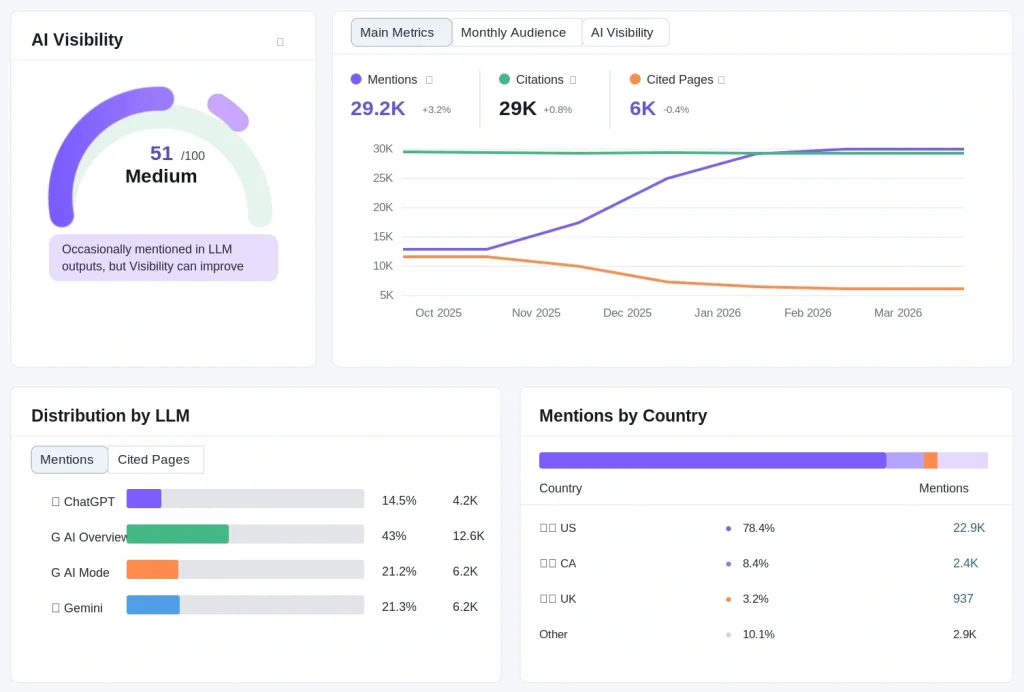
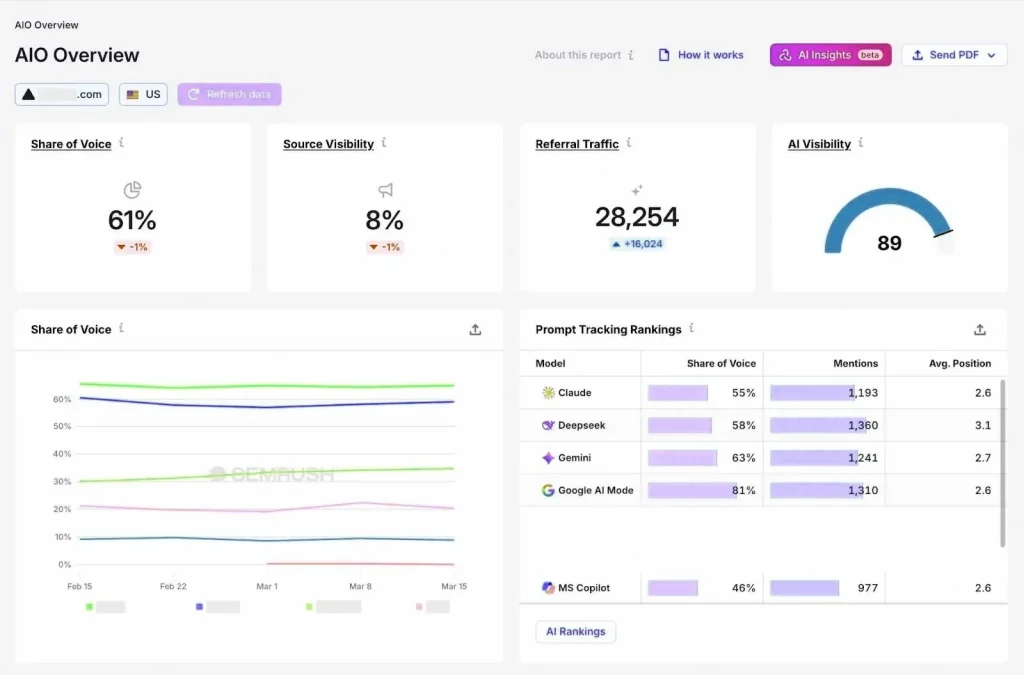
Paid trackers automate the third check. In Semrush’s AI visibility reports, for example, you can see share of voice, mentions, and average position by AI model.
Another view separates mentions (your brand is named) from citations (your page is linked), and shows which AI engine drives each.
Frequently Asked Questions About GEO
-
What is generative engine optimization?
It’s the practice of optimizing content and brand signals so AI tools like ChatGPT, Gemini, and Perplexity can find, trust, and cite your pages in their answers.
-
Is GEO the same as SEO?
No, but they overlap heavily. SEO aims to rank pages in search results. GEO aims to get your information cited inside AI answers. Both depend on crawlable, high-quality, trustworthy content.
-
Is GEO replacing SEO?
No. Google states its generative AI features are rooted in its core ranking and quality systems, so SEO best practices still apply. Think of GEO as an added layer, not a replacement.
-
What is the difference between GEO and AEO?
AEO grew out of featured snippets and voice answers. GEO targets generative AI responses. Today they’re close enough that most teams treat them as one workflow.
-
How do you do GEO?
Fix your technical basics, allow the right crawlers, lead sections with direct answers, add sourced facts and original insight, and earn real mentions. Then test a fixed prompt list every month.
-
Does llms.txt help with GEO?
Not for Google Search, which ignores it. No major engine has confirmed that it changes citation eligibility, so treat it as optional.
-
How long does GEO take to work?
Nobody can promise a fixed timeline. Because GEO builds on indexing and content quality, it moves at a similar pace to SEO. In my projects, early movement usually shows within 60 to 90 days.
-
Do you need paid tools for GEO?
No. Search Console, GA4, and manual prompt checks cover the basics. Google also warns that no third-party tool has access to its internal ranking or AI systems, so treat tool scores as estimates.
Final Thoughts
Generative Engine Optimization isn’t a replacement for SEO. It’s what good SEO looks like when AI answers sit between your brand and the click. Get the foundations right, publish content worth citing, and measure it honestly.
If you want to see how this plays out on real projects, browse my case studies.