
Client: High-End Regional Local Service Provider (US — identity confidential under NDA) Lead Consultant: Nayem Khan — Founder & Lead SEO Consultant, Antor SEO Timeline: 90 Days (3-Month Sprint) Services: Local GEO (Generative Engine Optimization), Entity & Local Business Schema, Direct-Answer Service Silos
At a Glance
| Metric | Previous 3 Months | Last 3 Months | Change |
|---|---|---|---|
| Generative AI Impressions (Google Search Console) | 148 | 1.28K | +764% (8.6x) |
| Reporting Source | Google Search Console — Performance > Generative AI Features (Beta) | ||
| Daily Peak Impressions | Flat, under 10–20/day | Spikes to 400+/day (around day 50) |
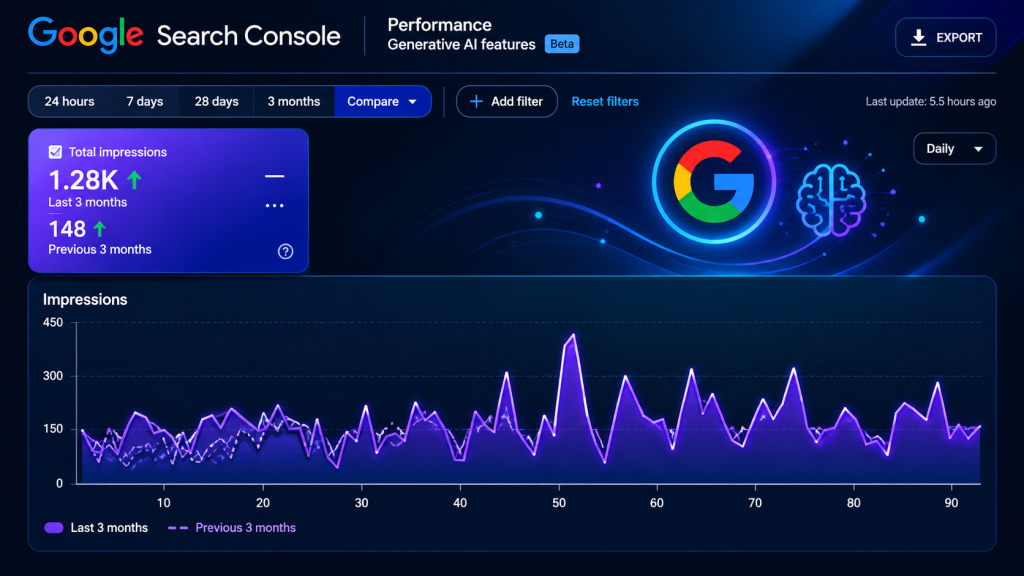
Client identity is masked per NDA. The Search Console figures above are reported exactly as they appeared in the client’s Performance report and have not been rounded up or embellished.
The Challenge: The Local “AI Overview” Squeeze
As Google rolled out AI Overviews for local, conversational queries — “how to choose the best [service] in [city],” “average cost of [service] near me,” “is [service] worth it” — the local map pack and traditional organic listings got pushed further down the mobile screen, sometimes below the fold entirely. A high-ticket local service business now has to earn a citation inside the AI answer itself, not just a pin on the map.
This client was essentially invisible in that layer: 148 AI impressions across an entire quarter — a rounding error for a business competing in a dense metro market. The root cause was structural, not a lack of effort:
- Service pages were written in generic marketing copy, with no direct answers to the pricing, process, or timeline questions people were actually typing into Google.
- FAQs existed but weren’t structured or specific enough for an LLM to lift with confidence.
- There was no structured entity data — no LocalBusiness, Service, or geo data — telling Google’s models exactly what the business does, where it operates, and who’s credentialed to do it.
The pattern will look familiar to anyone who’s read our e-commerce GEO case study: different vertical, same underlying problem — a site built for human skimmers, not for the systems now assembling the answer before a human ever scrolls to it.
The 3-Phase Local GEO Blueprint
Here’s the exact sequence Nayem Khan ran with the client’s team over the 90-day sprint, drawing on the same entity-and-schema methodology documented across our verified case studies.
Phase 1 — Local Entity & Nested Schema Deployment
The first move was making the business legible to Google’s models as a specific, verifiable local entity. That meant deploying rich, nested JSON-LD:
- LocalBusiness schema tied to verified NAP (name, address, phone) data
- Service schema for each individual offering, not just one generic services page
- GeoCoordinates and service-area boundaries, so algorithms could confirm exactly where the business does and doesn’t operate
- Credential and licensing markup, critical for a high-ticket, trust-sensitive category
This gave Google’s AI systems a confident basis to answer “does this business serve my area” or “are they licensed for X” without guessing.
Phase 2 — Direct-Answer Local Content Architecture
Key service landing pages were rebuilt around the questions people actually ask before calling:
- Concise 2–3 sentence direct-answer summaries placed immediately beneath each H2, covering pricing ranges, process, and emergency availability
- FAQ blocks rewritten around real local search phrasing rather than generic industry copy
- Clear separation between informational content (educating the buyer) and transactional content (getting them to call)
Phase 3 — Local Consensus & Verification Signals
Local citation inside an AI Overview depends heavily on consensus: does the business’s Google Business Profile, third-party directories, and review content all agree with what the website claims? Phase 3 aligned Google Business Profile attributes, cleaned up inconsistent directory listings, and worked authentic customer review themes into the entity signal Google’s models look for before recommending a local vendor by name. For more on how Google surfaces AI features across Search, see Google’s own documentation on AI features in Search.
Verified Results: The Search Console Data
The Performance > Generative AI Features (Beta) report in Google Search Console is the clearest read on whether a local business is actually being surfaced inside AI Overviews rather than just ranking in the traditional map pack.
Over the 90-day sprint, generative AI impressions went from 148 in the prior 3-month window to 1,280+ in the most recent 3-month window — a +764% increase, or an 8.6x surge in AI search visibility.
The daily trend shows exactly when the shift happened. For most of the first month, daily impressions stayed flat, hovering under 10–20 per day — essentially no presence. Around day 50, that changed sharply: daily impressions began spiking to 400+ in a single day, with recurring high-volume citation spikes continuing through the rest of the sprint rather than a one-off blip.
Why this matters commercially: for a high-ticket local service, an AI Overview citation isn’t a vanity metric — it’s the moment a prospect goes from “researching options” to “calling the recommended one.” Losing that citation to a competitor means losing the call before the phone even rings. Winning it back is a direct line to more quote requests, not just more impressions.
Key Takeaways for Local Service Businesses
- Map pack rankings alone no longer guarantee visibility. A strong Google Business Profile position doesn’t matter if the AI Overview above it is citing a competitor instead — this is the core reason Nayem Khan treats local SEO, AEO, and GEO as one strategy, not separate line items.
- Structured, verifiable entity data is now a prerequisite. If Google’s models can’t confirm your service area, credentials, and offerings from structured data, they have no confident basis to recommend you over a competitor with cleaner markup.
- Consensus across the web compounds trust. A local business’s own website is only one data point. When Google Business Profile, directories, and reviews all tell the same consistent story, that consensus is what tips an LLM toward citing a specific vendor by name.
Is Your Business Being Cited — Or Is a Competitor Getting the Call?
If your service pages weren’t built with AI citation in mind, a competitor down the street may already be capturing the calls you’re losing before a prospect ever reaches your listing. Get in touch with Nayem Khan for a 1-on-1 Local SEO & GEO Audit, or see more verified results across industries.