
Client: Premium D2C E-Commerce Retailer (US/Global — identity confidential under NDA) Lead Consultant: Nayem Khan — Founder & Lead SEO Consultant, Antor SEO Timeline: 90 Days (One Quarterly Sprint) Services: Generative Engine Optimization (GEO), Merchant Schema Architecture, Buyer-Intent Direct Answers
At a Glance
| Metric | Previous 3 Months | Last 3 Months | Change |
|---|---|---|---|
| Generative AI Impressions (Google Search Console) | 4.77K | 15.3K | +220% (3.2x) |
| Reporting Source | Google Search Console — Performance > Generative AI Features (Beta) | ||
| Daily Peak Impressions (baseline vs. end of sprint) | ~100–150/day | 350–375+/day |
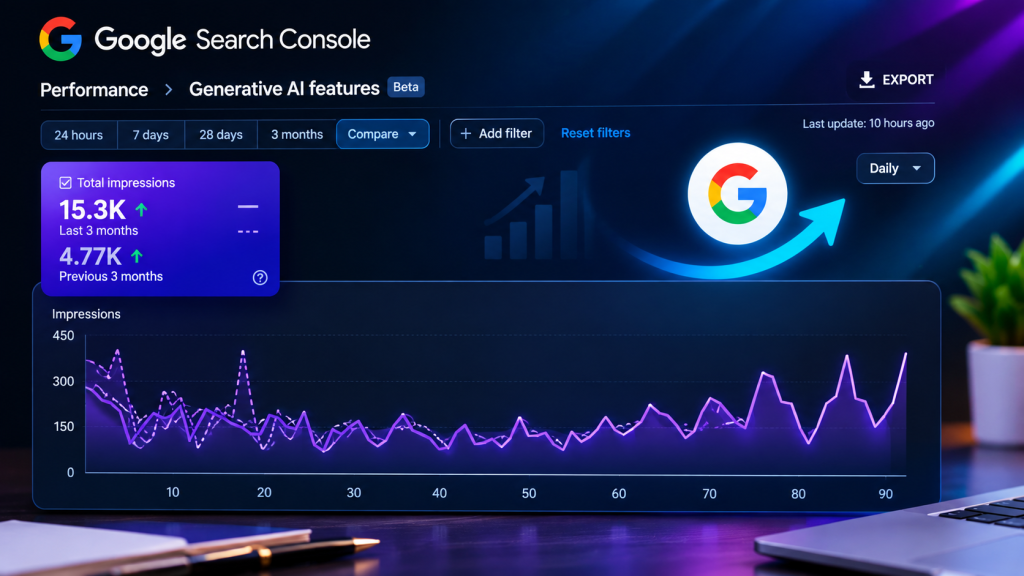
Client identity is masked per NDA. The Search Console figures referenced above are reported exactly as they appeared in the client’s Performance report and have not been rounded up or embellished.
The Challenge: The E-Commerce “Zero-Click” AI Squeeze
Since Google began surfacing AI Overviews across commercial queries, product discovery has quietly shifted. For a growing share of searches — “best [product category] for [use case],” “top rated [product] alternatives,” “[product] vs [competitor]” — Google’s generative layer now assembles its own answer directly inside the SERP, often before a shopper ever scrolls to organic listings or category pages.
That’s a structural problem for D2C brands that built their acquisition funnel around ranking, not being cited. It’s the same pattern behind every result documented across our verified GEO and SEO case studies: visibility that used to live in the 10 blue links is migrating into AI-generated answers, and brands that haven’t adapted their content architecture are the ones losing it.
When we onboarded this client, their product and category pages were built for human skimmers, not for the entity-extraction systems behind AI Overviews. Specifically:
- Product pages lacked machine-readable pricing, availability, and review data.
- Category pages made claims (“best-selling,” “top-rated”) with no structured comparison data to back them.
- There was no consistent third-party corroboration of product specs or trust signals across the web — something generative systems lean on heavily before citing a brand.
The result: the brand was present in traditional organic results but nearly invisible inside the AI-generated answers that were increasingly sitting above those results.
The 3-Phase GEO Execution Blueprint
Here’s the exact sequence Nayem Khan ran with the client’s team over the 90-day sprint.
Phase 1 — Product & Merchant Schema Overhaul
The first priority was making the catalog legible to AI systems, not just search crawlers. That meant deploying and validating advanced JSON-LD markup across the full product catalog:
- Product and Offer schema, kept in sync with live pricing
- AggregateRating, pulled directly from verified review data
- MerchantReturnPolicy, so return terms are machine-readable rather than buried in a footer link
- ItemAvailability, updated in real time with inventory
This gave Google’s AI systems a confident, structured basis to answer questions like “is this in stock” or “what’s the return policy” without needing to guess from page copy.
Phase 2 — Direct-Answer Buying Guide Architecture
Category hub pages were restructured around how generative systems actually parse content for citation:
- Structured comparison tables instead of long-form prose
- Explicit pros/cons blocks per product
- Tight, 2-sentence direct-answer summaries positioned at the top of each buying guide, written to directly resolve a buyer’s question rather than lead into it
This is the layer most e-commerce sites skip — and it’s the layer AI Overviews pull from most readily, because it minimizes the model’s own summarization work. The same direct-answer restructuring is what pushed CTR to 9.6% in our real estate SEO case study, where commercial pages saw a comparable lift once buyer questions were answered up front instead of buried in prose.
Phase 3 — Entity Consensus & Third-Party Footprint
Generative systems weigh corroboration heavily: if a product’s specs and claims only exist on the brand’s own site, that’s a weaker citation signal than specs confirmed across independent sources. Phase 3 focused on synchronizing accurate product specifications and trust signals across external review platforms and community discussions — the kind of third-party footprint AI search models reference to validate what a brand says about itself. For background on how Google’s own systems describe this citation behavior, see Google’s documentation on AI features in Search.
The same entity-consensus mechanics drove the results in our healthcare SEO case study for Next Health — the approach holds across verticals, even when the product being cited is very different.
Verified Results: The Search Console Data
The Performance > Generative AI Features (Beta) report in Google Search Console is the most direct way to see whether a domain is actually being surfaced inside AI Overviews and related generative search experiences.
Over the 90-day sprint, the client’s generative AI impressions went from 4,770 in the prior 3-month window to 15,300+ in the most recent 3-month window — a +220% increase, or roughly a 3.2x surge in AI search visibility.
The daily trend tells the more useful story. Early in the sprint, daily generative impressions hovered around 100–150 per day — a fairly flat baseline. By the back half of the sprint, as the schema overhaul and buying-guide restructuring took effect, daily impressions were regularly peaking at 350–375+ per day, with the growth trend accelerating rather than plateauing toward the end of the window.
Why this matters commercially: a citation inside an AI Overview captures a shopper at a later, more decided stage of intent than a standard blue link — often before they’ve scrolled to organic results at all. Losing that placement doesn’t just mean losing a rank position; it means losing visibility at the exact moment a shopper is ready to buy. Winning it back is a direct defense of product revenue, not just a visibility metric.
Key Lessons for E-Commerce & D2C Founders
- Traditional on-page SEO is necessary but no longer sufficient. Ranking on page one doesn’t guarantee visibility if Google’s AI layer is answering the query before the shopper reaches the results — this is the core thesis behind how Nayem Khan approaches SEO, AEO, and GEO as one unified strategy rather than separate disciplines.
- Structured data is the new floor, not a nice-to-have. If your product, pricing, and policy data isn’t machine-readable, generative systems have no confident basis to cite you — no matter how strong your copy is.
- Third-party corroboration compounds. A single well-optimized product page is weaker than the same claims confirmed independently elsewhere on the web. Entity consensus is now part of the ranking (and citation) equation.
Is Google’s AI Citing Your Store — Or Your Competitor’s?
If your product pages weren’t built with AI citation in mind, there’s a good chance a competitor is already capturing the buyer-intent queries you’re losing. Get in touch with Nayem Khan for a 1-on-1 Technical & GEO Audit to find out where your catalog stands, or browse more verified results across industries.