
Key Takeaways
- Bottom-of-funnel (BOFU) content is written for people who are close to buying: comparisons, alternatives, pricing, use case and integration pages.
- For SaaS, BOFU pages usually bring fewer visitors than blog posts, but those visitors are ready to choose a tool, so they tend to convert better.
- The core BOFU page types are product vs competitor, competitor alternatives, best tools lists, use case pages, integration pages and pricing.
- Google’s guidance on reviews applies to comparison pages: show real experience, evidence, measurements and honest pros and cons.
- Build BOFU pages first, then support them with mid and top-of-funnel content that links to them.
Many SaaS blogs are full of top-of-funnel posts like “what is project management” that bring traffic but few customers. Meanwhile, the searches that lead straight to a sign-up, like “[competitor] alternatives” or “[your product] vs [competitor],” often go to competitors and review sites.
Bottom-of-funnel content fixes that. This guide covers the BOFU page types that work for SaaS, how to write them honestly, and how to fit them into a wider SaaS SEO strategy.
What Is Bottom-of-Funnel Content?
The marketing funnel has three stages. Top of funnel (TOFU) content educates people who are just learning about a problem. Middle of funnel (MOFU) content helps them compare approaches. Bottom of funnel content helps people who already know what kind of tool they need choose a specific one.
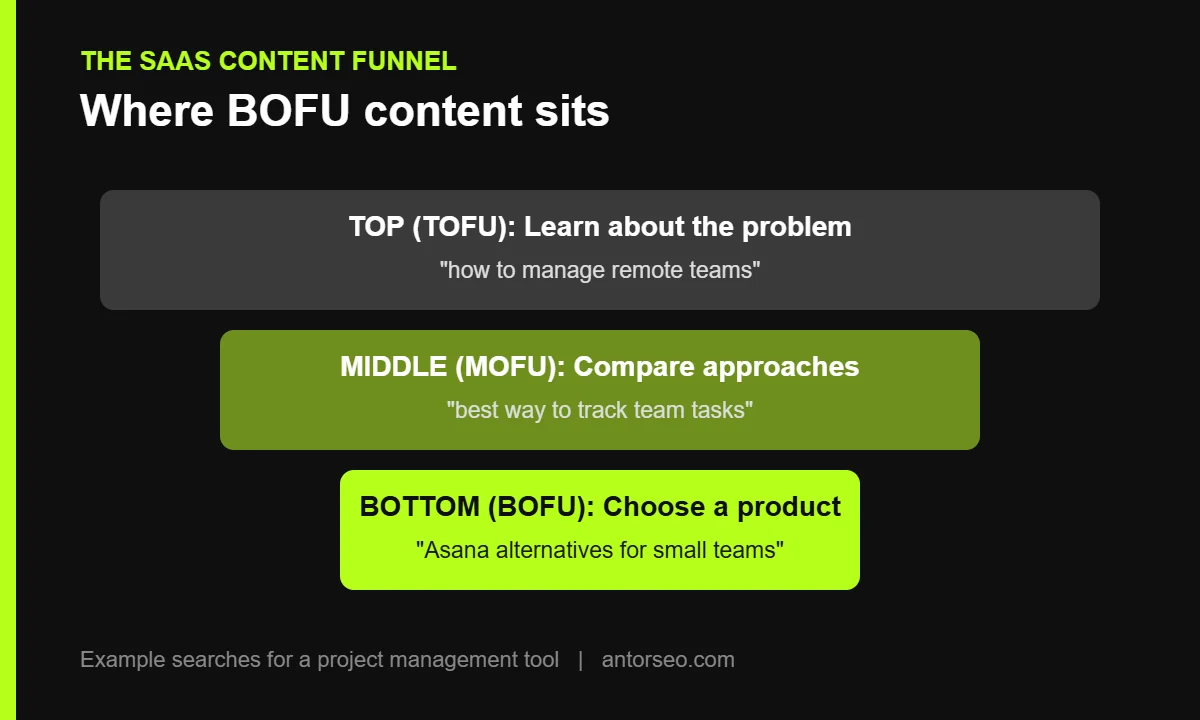
| Funnel stage | Example search | Goal |
|---|---|---|
| Top (TOFU) | how to manage remote teams | Attract and educate |
| Middle (MOFU) | best way to track team tasks | Show your approach |
| Bottom (BOFU) | Asana alternatives for small teams | Win the sign-up or demo |
BOFU searches have lower volume, but the person searching is ready to act. That is why one strong comparison page can bring more trials than dozens of general blog posts.
The Main BOFU Page Types for SaaS
1. Product vs Competitor Pages
Pages like “YourProduct vs Competitor” target people choosing between two tools. Compare features, pricing, ease of use, support and best-fit customers in a clear table. Be honest about where the competitor is stronger. Readers can tell when a comparison is one-sided, and they leave.
2. Competitor Alternatives Pages
People search “[competitor] alternatives” when they are unhappy with a tool or find it too expensive. List several real alternatives, including yours, and explain who each one suits. Lead with the problems that make people switch, such as price, missing features or complexity.
3. Best Tools Lists
“Best [category] software for [audience]” pages attract buyers early in their decision. Include your product, but also competitors, and back up every pick with reasons. Google’s guidance says “best” picks should be justified with first-hand evidence.
4. Use Case Pages
Pages for specific jobs, such as “CRM for real estate agents” or “invoicing software for freelancers,” match searches from people with a clear need. Show how your product solves that exact workflow, with screenshots and examples.
5. Integration Pages
Searches like “[tool] integration with Slack” come from active users of another product. A page for each important integration, explaining what it does and how to set it up, captures this demand and helps product-led growth.
6. Pricing Page
Many buyers search “[your product] pricing” before signing up. A clear, indexable pricing page with plan comparisons and answers to common billing questions is often among the best-converting pages on a SaaS site. We cover pricing clarity in our SEO cost guide from the buyer’s side.
How to Write BOFU Content That Ranks and Converts
Comparison and alternatives pages are a type of review content. Google’s guidance on writing high-quality reviews gives a useful checklist:
- Evaluate from the buyer’s point of view. Focus on the factors that actually decide the purchase.
- Show real experience. Use your own screenshots, test results and setup notes, not specs copied from websites.
- Share measurements. Setup time, pricing at different team sizes, limits on each plan.
- Explain what sets each option apart, and which one suits which situation.
- Cover benefits and drawbacks honestly, including your own product’s limits.
Practical writing tips:
- Put a short verdict near the top so busy readers get the answer fast.
- Use comparison tables for features and pricing, and check every fact against the competitor’s own site.
- Add the date you last checked pricing, and update it regularly.
- Include customer quotes or results where you have permission.
- End with a clear next step: start a trial, book a demo or see pricing.
How to Find BOFU Keywords
- List your top competitors and search “[competitor] alternatives” and “[competitor] vs” for each.
- Ask your sales team which tools prospects compare you with.
- Read support tickets and churn reasons to find the problems people want to solve.
- List the tools your customers use alongside yours, for integration pages.
- Check Search Console for queries with your brand plus words like “pricing,” “vs,” “review” or “alternative.”
Our keyword research guide explains how to judge difficulty and intent for each keyword.
Where BOFU Fits in a SaaS SEO Plan
Start with BOFU pages, because they turn traffic into revenue fastest. Then build MOFU and TOFU content that links to them, so authority from popular guides flows to the pages that convert. This approach is part of the SaaS SEO work we do for clients, and it ties into GEO and AEO for SaaS companies, since AI assistants are often asked the same comparison questions.
Common BOFU Content Mistakes
- Writing comparisons that never admit a competitor is better at anything.
- Using outdated competitor pricing or features.
- Hiding pricing pages from search or behind forms.
- Building one “vs” page and stopping, instead of covering every major competitor.
- Leaving BOFU pages without internal links from the rest of the site.
Frequently Asked Questions
What is BOFU content in SaaS?
It is content for people close to buying, such as comparison, alternatives, pricing, use case and integration pages.
Is it legal to mention competitors by name?
In most markets, accurate and fair comparison is allowed. Stick to facts you can verify, avoid misleading claims, and check local advertising rules if you are unsure.
Should my product always be ranked first?
Not always. Readers trust lists that explain who each option suits. Being honest about fit often converts better than claiming to be best for everyone.
How many BOFU pages should a SaaS site have?
Start with one comparison page for each main competitor, an alternatives page for the top two or three, your pricing page and your most important use cases. Add more as you learn what prospects search.
Does BOFU content help with AI search?
Yes. People ask AI assistants comparison questions too, and clear, honest comparison pages give those tools accurate information to cite.
Running a SaaS company? Our SaaS SEO service builds BOFU pages that convert, or start with a free SEO audit.