Key Takeaways
- Digital PR is the practice of creating stories, data or expert commentary that journalists and publishers want to cover, so your brand earns links and mentions on trusted sites.
- Links earned through real coverage are within Google’s rules. Paying for links that pass ranking credit, including paid guest posts and press releases with optimized anchors, is link spam.
- Coverage now matters twice: as links for classic search, and as trusted mentions that AI assistants use when they describe brands.
- The strongest campaigns use original data, expert reactions to news, or useful tools that journalists cannot get anywhere else.
- Measure coverage quality, referral traffic, branded search and leads, not just the number of links.
Most small businesses think of link building as asking for links. Digital PR works the other way around. You create something worth writing about, and journalists, bloggers and industry sites link to you because it improves their story.
Done well, digital PR builds the kind of links Google trusts and the brand mentions AI assistants rely on. This guide covers how it works, the campaign types that get coverage, how to pitch, and the rules that keep it safe.
What Is Digital PR?
Digital PR combines public relations with SEO. The goal is coverage on relevant, trusted websites: news sites, industry publications, popular blogs and local media. That coverage usually includes a link, a brand mention, or both.
It differs from traditional PR in focus. Traditional PR cares mostly about reach and reputation. Digital PR also cares about the links and the search visibility that coverage brings. It differs from typical link building because you do not ask for a link directly. You earn it by giving the writer something useful.
Why Digital PR Matters for SEO and AI Search
- Trusted links. Links from respected publishers are hard to get and hard for competitors to copy.
- Brand mentions. AI assistants build their picture of a brand from what trusted sites say about it. Coverage helps them describe you accurately. We explain this in generative engine optimization.
- Authority for E-E-A-T. Being quoted as an expert supports the experience and expertise signals covered in our E-E-A-T guide.
- Real referral traffic. A good story sends readers, not just link value.
What Google Allows, and What It Does Not
Google’s spam policies define link spam as creating links mainly to manipulate rankings. The examples include buying or selling links for ranking purposes, and advertorials, guest posts or press releases on other sites where paid links pass ranking credit or use optimized anchor text.
Google also says paid links for advertising or sponsorship are fine as long as they are marked with rel="sponsored" or rel="nofollow".
In practice:
| Activity | Within Google’s rules? |
|---|---|
| A journalist covers your study and links to it | Yes, this is earned coverage |
| You give expert comments and a writer credits you with a link | Yes |
| You pay a site to publish an article with a followed link | No, unless the link is marked sponsored or nofollow |
| You send a press release through a wire service with keyword anchor links | No, if the links pass ranking credit |
| You send a free product in exchange for a review with a link | Only if the link is qualified |
Google’s AI optimization guide adds that seeking inauthentic mentions is not as helpful as it seems, because spam systems catch it. The safe path and the effective path are the same: earn coverage with something real.
Digital PR Campaign Types That Work
1. Original Data and Research
Journalists need fresh numbers. Survey your customers, analyze public data, or publish findings from your own work. For an SEO consultant, that could be a study of how local businesses appear in AI answers in one city. For a clinic, it could be anonymized trends in common patient questions.
2. Expert Reaction to News
When news breaks in your industry, journalists look for quick, quotable expert comments. Prepare a short, clear opinion with one specific insight and send it while the story is fresh. Services that connect journalists with sources can help you find requests.
3. Useful Tools and Calculators
A free calculator, checker or template can earn links for years. Examples include a pricing calculator, a readiness checklist or an interactive map.
4. Local Stories
Local news sites cover local businesses that do something newsworthy: community events, sponsorships, hiring news or local data. These links also support local citations and local rankings.
5. Visual Assets
Charts, maps and infographics built from your data are easy for writers to embed and credit, which makes a link more likely.
How to Run a Digital PR Campaign
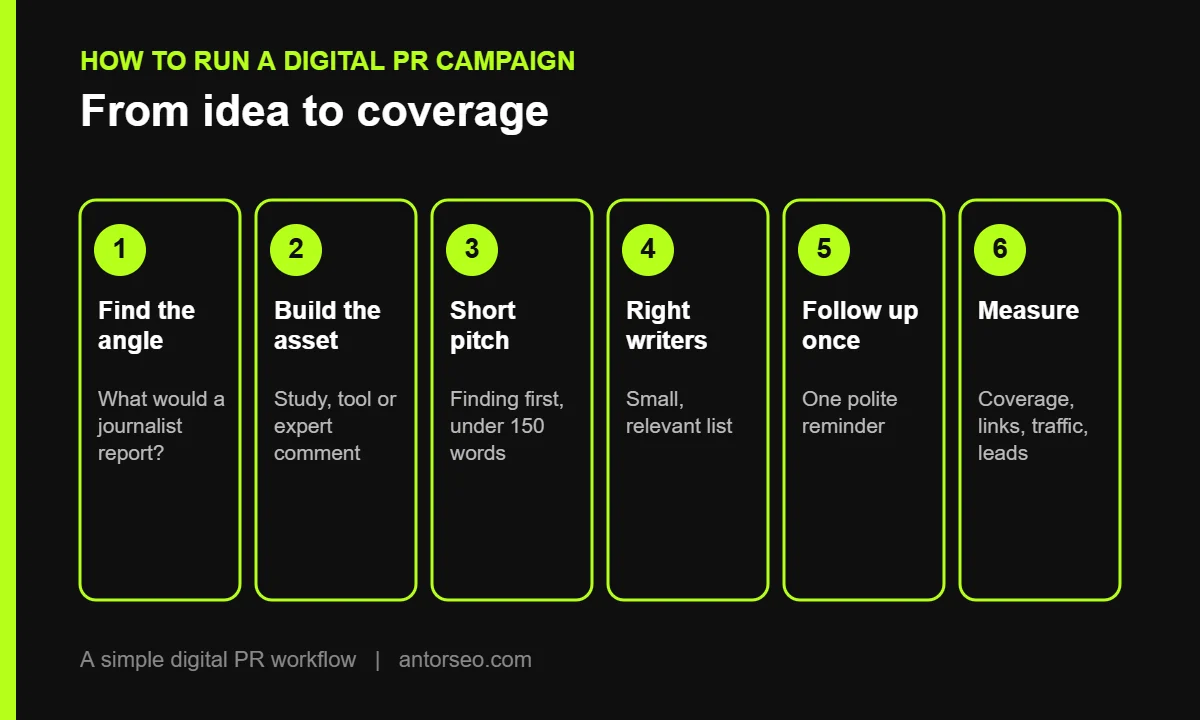
- Find the angle. Ask what a journalist in your industry would want to report this month.
- Build the asset. Create the study, tool or expert comment, with a clear headline finding.
- Write a short pitch. Lead with the finding, explain why it matters to their readers, and keep it under 150 words.
- Target the right writers. Pitch journalists who have covered similar topics recently. A small, relevant list beats a mass email.
- Follow up once. A single polite follow-up after a few days is enough.
- Track results. Record each piece of coverage, whether it links, and what traffic it sends.
How to Measure Digital PR
- Coverage quality: relevance and trust of the sites, not only the count.
- Links: how many pieces of coverage include a link, and to which pages.
- Referral traffic: visits and conversions from coverage, tracked in GA4.
- Branded search: growth in people searching your brand name in Search Console.
- AI mentions: whether AI assistants mention your brand more often, measured with AI visibility tools.
Common Digital PR Mistakes
- Pitching stories that only promote your business.
- Sending the same pitch to hundreds of unrelated writers.
- Making claims your data cannot support.
- Asking for a specific anchor text or a followed link.
- Giving up after one campaign. Results build as journalists learn to trust you as a source.
Frequently Asked Questions
Is digital PR the same as link building?
It is one form of link building, focused on earning coverage rather than asking for links. It usually produces fewer but stronger links and brand mentions.
Are press releases good for SEO?
A press release can lead to coverage if journalists pick up the story. Links inside the release itself should be qualified, because Google’s spam policy lists press releases with paid links that pass ranking credit or use optimized anchors as link spam.
How long does digital PR take to show results?
Coverage can come within days of a good pitch. The SEO impact of links and mentions builds over the following months.
Can small businesses do digital PR?
Yes. Local stories, expert comments and small surveys work well and do not need a big budget.
Does digital PR help with AI search?
Yes. AI assistants rely on what trusted sites say about a brand. Earned coverage gives them accurate, credible information to use.
Want a digital PR angle for your business? We can help, starting with a free SEO audit of your current links and mentions. See also our guide to off-page SEO.