
What is off-page SEO?
Off-page SEO is the work done outside your website to build awareness, reputation, relationships and references that support your site’s visibility in organic search. It includes earning relevant editorial links, digital public relations, brand mentions, expert contributions, local citations, community participation and online reputation management.
Backlinks are an important part of off-page SEO, but off-page SEO is broader than link building. A business can build recognition through a trusted publication, an industry association, a podcast appearance, a useful research report, a customer review or a local business listing — even when every mention does not produce a followed backlink.
The central principle is simple: create something useful or credible enough that relevant people and organizations want to reference it. Off-page SEO should strengthen the website’s real reputation, not manufacture the appearance of popularity. If you’re new to the discipline as a whole, it helps to first understand what SEO is and how search engine optimization works before layering off-page strategy on top.
Why is off-page SEO important?

Search engines use links and other signals to discover pages and understand relationships across the web. Google says that links can be a signal when determining page relevance and can help it find new pages to crawl.
Off-page activities also create benefits outside ranking. A relevant feature can introduce your brand to a new audience, an expert citation can increase trust, a partnership can create referral traffic, and a strong local profile can help people choose your business.
Off-page SEO is most effective when it follows useful content and a clear brand purpose. If a page has nothing valuable to reference, acquiring links to it is difficult and often leads to low-quality tactics. Build the destination first; then promote it to people who genuinely benefit from knowing about it. For a deeper breakdown of how this fits into a search strategy overall, Search Engine Land’s guide to off-page optimization is a useful companion read.
Off-page SEO vs. on-page SEO vs. technical SEO
| Area | Main focus | Examples |
|---|---|---|
| On-page SEO | Improving content and elements on a page | Search intent, headings, titles, copy, images, URLs and internal links |
| Technical SEO | Improving access, rendering and website infrastructure | Crawlability, indexability, performance, sitemaps, canonicals and JavaScript |
| Off-page SEO | Building reputation and awareness beyond the site | Editorial links, digital PR, mentions, citations, partnerships and communities |
These areas work together. On-page SEO creates a strong page, technical SEO makes it accessible and understandable, and off-page SEO helps the right external audiences discover and reference it. If you haven’t optimized the page itself yet, start with our guides on on-page SEO and technical SEO before investing heavily in off-page work.
What is a backlink?
A backlink is a link from another website to your website. It may send referral traffic, help users discover a resource and provide contextual information about the relationship between pages.
Not all backlinks are equal. Relevance, editorial context, source credibility, placement, destination quality and the reason the link exists are more meaningful than a simple link count. A single relevant reference from a respected publication can be more valuable to a business than hundreds of unrelated directory links.
A backlink is strongest when it is editorially earned. That means the publisher chose to reference the page because it was useful, original, credible or relevant to its readers — not because the site owner paid for ranking credit or used an automated system.
Followed, nofollow, sponsored and UGC links
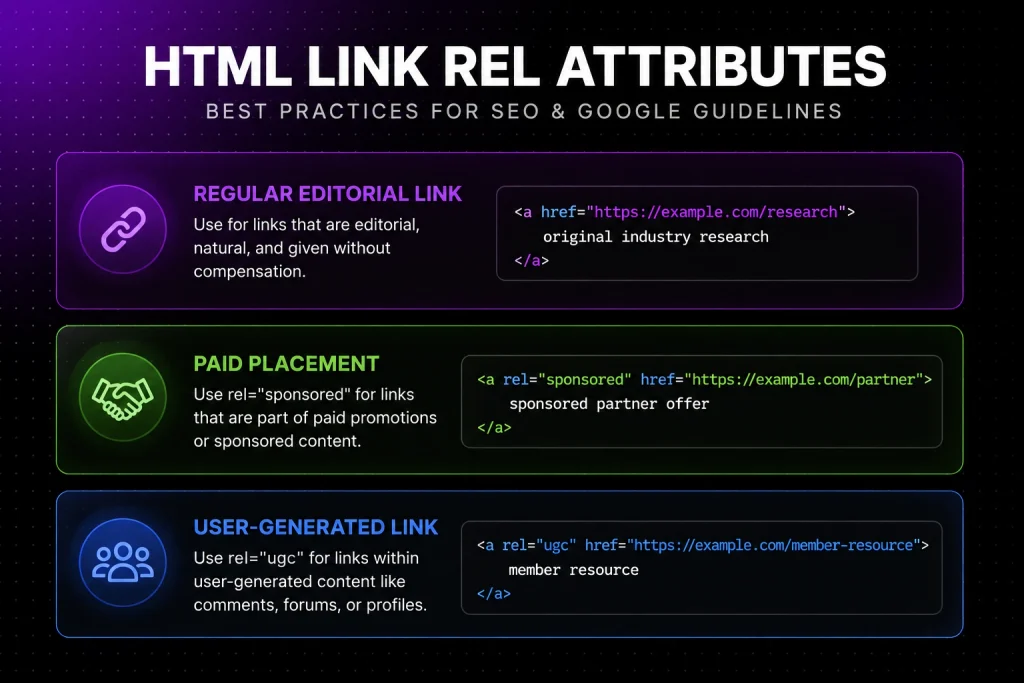
Google provides rel values that help site owners describe their relationship with a linked page. Regular editorial links do not require a special rel attribute. Paid or advertising links should use rel=”sponsored”; user-generated links such as forum and comment links should use rel=”ugc”; and rel=”nofollow” can be used when the other values do not apply and the site owner does not want to associate with the destination.
These attributes communicate context. They are not a license to create artificial links, and no particular attribute guarantees a ranking outcome.
Examples:
The best off-page SEO techniques
1. Create linkable assets
A linkable asset is a resource that other websites have a practical reason to reference. Examples include original research, survey findings, calculators, templates, technical documentation, visual explainers, public datasets, expert interviews, comprehensive guides and genuinely useful tools.
The asset must be relevant to a clearly defined audience. A generic article that repeats information available everywhere gives publishers little reason to cite it. Add original data, a unique method, a strong visual, a useful framework or a perspective grounded in real experience.
Before creating an asset, identify who might use or reference it. A research report may appeal to journalists and analysts; a calculator may appeal to practitioners; a local study may appeal to regional publications and organizations.
2. Use digital PR
Digital PR combines newsworthy ideas, research, expert commentary and relationship-building with media outreach. Its goal is not to distribute the same promotional article to hundreds of sites. Its goal is to give a relevant journalist, editor or publisher a credible reason to cover a story.
A strong digital PR campaign begins with a real angle: new data, a meaningful trend, a customer problem, an original expert analysis or a timely response to a development. Package the findings clearly, explain the methodology and make assets easy for publishers to review.
Media coverage may produce links, brand mentions, referral traffic or all three. Do not treat a link as the only measure of success; a relevant audience and credible brand recognition may be valuable even when a publisher does not link in the way you expected.
3. Earn expert citations and thought-leadership mentions
Publishers need informed sources. Demonstrate expertise through well-supported articles, public commentary, conference contributions, expert interviews, professional associations and useful responses to industry questions.
Avoid mass replies that make vague claims. Offer a specific insight, explain why it matters and disclose relevant commercial relationships. A genuine contribution can lead to a citation, interview, referral visit or future collaboration.
4. Build relationships through ethical outreach
SEO outreach is the process of contacting relevant website owners, editors, journalists or organizations about a resource, collaboration or story. Effective outreach is selective and personalized.
A useful outreach message identifies the recipient, explains the relevance, describes the resource briefly and makes a clear, low-pressure suggestion. Do not demand a followed link, pretend to have read a page you did not read or send the same template to an irrelevant list.
Example structure:
| Subject: A data point for your guide on [topic] I noticed your guide covers [specific section]. We recently analyzed [specific dataset or method] and found [brief, relevant insight]. If useful for your readers, the methodology and full result are available here: [URL]. No action is required if it is not a fit. |
The purpose of outreach is to make a relevant connection, not to pressure someone into passing ranking credit.
5. Use guest contributions carefully
Guest contributions can build relationships and expose your expertise when the publication has a real audience and the content is original. They become risky when the primary purpose is to place optimized anchor text at scale or publish thin articles across unrelated sites.
Choose publications for audience relevance, editorial standards and genuine value. Write something specifically useful to that publication’s readers. Disclose commercial relationships and qualify paid links appropriately. Never submit the same article to many sites or use guest posting as a volume-based link scheme.
6. Strengthen local SEO and citations
For businesses serving a specific location, local off-page SEO may include accurate business profiles, relevant local directories, industry associations, community involvement, local press coverage and customer reviews.
Consistency matters. Keep the business name, address, phone number, website and categories accurate across important platforms. Do not create duplicate listings, keyword-stuff business names or place the business in irrelevant directories merely to obtain links.
Local relationships can produce stronger outcomes than broad, unrelated link campaigns. Sponsoring a relevant community event, publishing useful local research or collaborating with a regional organization may build visibility, trust, referral traffic and legitimate mentions.
7. Encourage authentic reviews and reputation signals
Reviews can influence customer decisions and local visibility, but they must reflect genuine customer experiences. Do not buy reviews, create fake profiles or pressure people to publish a particular sentiment.
Respond professionally to criticism, resolve real service problems and make it easy for legitimate customers to share feedback. Reputation management is not about hiding every negative comment; it is about improving the underlying experience and communicating responsibly.
8. Participate in relevant communities
Industry forums, professional communities, Q&A platforms, social networks and events can help you learn what people need and share useful resources. Participation should be helpful even when no link or immediate conversion is possible.
Do not post keyword-rich links in every discussion. Google identifies optimized forum-comment links and low-quality distributed links as examples of link spam. Contribute an answer first, link only when it genuinely provides useful additional context, and follow each community’s rules.
Link building strategies that can work sustainably
Digital PR campaign framework: Choose a topic with genuine relevance, collect or create original evidence, package the findings in a clear page, prepare visual assets and identify journalists or publishers who cover the subject. Personalize pitches around their audience and previous work. Measure coverage, relevant referring domains, referral traffic, branded search interest, qualified leads and relationship quality. Some campaigns will produce many mentions but few links; others may produce a small number of highly relevant references. Evaluate the business outcome rather than using a single backlink count.
Resource-page outreach: Find genuinely relevant resource pages that already help a specific audience. Contact the owner only when your resource fills a clear gap or improves the page. Do not ask unrelated websites to add a link simply because they have a “resources” section.
Broken-link replacement: Identify a broken external link on a relevant page, create or find a genuinely suitable replacement on your website and explain the issue to the site owner. The replacement must serve the same user need. Do not create artificial “broken link” claims or propose an unrelated commercial page.
Unlinked brand mentions: If a credible publication mentions your business without linking, you may politely ask whether adding a link would help readers find the referenced resource. The request should be optional and easy to decline. A brand mention can still have value even when no link is added.
Original research and data journalism: Research is naturally linkable when the method is transparent, the sample is clear, the limitations are stated and the result answers a real industry question. Provide a concise summary, downloadable data where appropriate, charts with accessible labels and a clear citation URL. For more tactics along these lines, Backlinko’s off-page SEO guide covers additional angles worth reviewing.
What is link spam?
Google defines link spam as creating links to or from a site primarily to manipulate search rankings. Examples include buying or selling links for ranking purposes, exchanging money or goods for links, excessive reciprocal linking, automated link creation, low-quality directory links, keyword-rich hidden links, widely distributed footer or widget links, and optimized forum-comment links.
The key issue is intent and pattern. A paid sponsorship can be legitimate when it is disclosed and the link is properly qualified. A community profile can be useful when it represents a real person and provides accurate information. A business directory can be valuable when it is relevant and trusted. The same formats become problematic when they are created at scale primarily to manipulate ranking signals.
Off-page SEO tactics to avoid
Avoid private blog networks, bulk backlink packages, automated submission tools, link exchanges created solely for ranking, exact-match anchor text at unnatural scale, irrelevant guest-post networks, paid links without proper qualification, comment spam and low-quality directory submissions.
Do not use negative SEO tactics against competitors, create fake reviews, impersonate experts or misrepresent a commercial relationship. These approaches can damage reputation, violate platform rules and create search visibility risk.
How to measure off-page SEO
Off-page SEO should be measured with a combination of visibility, authority, audience and business metrics.
| Metric | What it can reveal | Important limitation |
|---|---|---|
| Relevant referring domains | Whether credible websites are referencing you | Quantity alone does not indicate quality |
| Referral traffic | Visitors arriving through external links | Some valuable links may send little traffic |
| Brand mentions | Awareness and reputation across the web | Mentions are difficult to compare consistently |
| Branded search interest | Whether more people search for your brand | Trends can be affected by many outside factors |
| Organic impressions and clicks | Whether search visibility is changing | Off-page work is only one possible cause |
| Qualified leads or sales | Business impact of visibility and referrals | Requires proper analytics and attribution |
| Local profile actions | Calls, directions and visits from local listings | Platform reporting varies by location |
Use Google Search Console to monitor impressions, clicks, queries and pages. Use analytics to evaluate referral behavior and conversions. Third-party backlink tools can help discover referring domains, anchor text and potential risks, but their link indexes are incomplete and should not be treated as Google’s private data.
Do not judge a campaign only by domain-rating-style scores. A relevant publication with a real audience may be more valuable than a high-scoring but unrelated site. Consider topical relevance, editorial quality, audience fit, traffic quality, brand safety and the reason the link exists. If your site also targets AI-driven discovery, it’s worth reading how GEO and AEO visibility work for SaaS and software brands, since off-page reputation increasingly feeds AI answer engines too.
How to conduct a backlink audit
Begin by exporting backlink data from more than one source if possible. Group links by referring domain, destination URL, anchor text, link placement, relevance, editorial context and qualification.
Look for patterns rather than reacting to one unfamiliar domain. Investigate sudden spikes, large numbers of exact-match anchors, sitewide links, unrelated language or topics, paid placements without qualification, hacked pages and links pointing to deleted or irrelevant destinations.
Not every low-quality link requires action. Google has systems designed to ignore many unnatural links. Do not panic and disavow every link you dislike. If there is a clear, sustained pattern of manipulative link building that you or an agency created, stop the practice, remove links where possible, review Google’s guidance and use the disavow process only when appropriate and understood.
Document the source, risk, action taken and follow-up date. A backlink audit should lead to better practices, not an endless attempt to control every mention of a brand on the web.
A practical off-page SEO workflow
- Define the business and audience: Identify the pages, products, services or ideas that deserve more discovery. Decide which audiences, publications, communities or partners would genuinely care about them.
- Improve the destination page: Before promotion, check that the page is accurate, useful, fast enough, easy to navigate and clear about the next step. A backlink cannot repair a poor destination experience.
- Create a reason to reference the page: Add original research, an expert view, a unique tool, a useful template, a strong visual explanation or a resource that fills a real information gap.
- Build a relevant prospect list: Prioritize publishers, organizations, experts and communities based on topical relevance, audience fit and editorial quality. Avoid large scraped lists of unrelated domains.
- Make a specific and honest approach: Personalize the message, explain the relevance and make the request optional. Never conceal payment, promise reciprocal links or demand a ranking-passing link.
- Nurture relationships: Thank people, share their work appropriately, respond to feedback and look for future ways to be useful. Sustainable off-page SEO is relationship-based rather than transaction-based.
- Measure and refine: Track coverage, relevant links, referral visits, brand signals, organic visibility and business outcomes. Repeat the approaches that create genuine value and stop tactics that produce only low-quality links.
Off-page SEO checklist
| Check | What to verify |
|---|---|
| Destination quality | The page being promoted is accurate, useful and technically accessible. |
| Audience fit | The prospect or community serves people who could benefit from the resource. |
| Link relevance | The link, if added, provides genuine context for the publisher’s readers. |
| Editorial value | The mention is earned because the resource is useful, original or credible. |
| Anchor text | Anchor text is natural and not over-optimized. |
| Paid links | Advertising or paid placements use appropriate rel="sponsored" qualification. |
| UGC links | Forum and comment links use rel="ugc" where appropriate. |
| Outreach quality | Messages are personalized, honest and optional rather than spammy. |
| Content originality | Contributions are unique and written for the publication’s audience. |
| Local accuracy | Business listings, contact data and reviews are genuine and consistent. |
| Measurement | Referral traffic, referring domains, mentions and business outcomes are tracked. |
| Risk control | Automated link creation, link schemes and manipulative patterns are avoided. |
Frequently asked questions
-
What is the difference between off-page SEO and link building?
Link building is one part of off-page SEO. Off-page SEO also includes digital PR, brand mentions, local citations, reviews, expert contributions, partnerships, communities and reputation-building. A complete strategy measures awareness and business value in addition to backlinks.
-
Are backlinks still important for SEO?
Relevant backlinks can help users discover resources and can be a signal in Google’s systems. Google also uses links to find new pages and understand relevance. However, backlink quantity does not guarantee rankings. Relevance, editorial context, destination quality and overall content usefulness matter.
-
How many backlinks do I need to rank?
There is no universal number. The answer depends on the query, competition, content quality, topic, authority and audience. Pursuing a fixed backlink count often encourages low-quality tactics. Build the best resource for the query and earn references from relevant sources.
-
Are paid backlinks illegal or always bad?
A paid placement can be a legitimate advertising or sponsorship arrangement, but links paid for ranking credit must be qualified appropriately. Google recommends rel=”sponsored” for advertisements and paid placements. Buying links specifically to manipulate rankings can violate Google’s link-spam policies.
-
Is guest posting good for off-page SEO?
Guest posting can be useful when it involves original, high-quality content for a real audience and supports genuine relationships. It becomes risky when used at scale primarily to acquire optimized links, especially across unrelated or low-quality websites.
-
Do nofollow links help SEO?
Nofollow links can send referral traffic, create visibility and help people discover a brand. Their treatment in search systems can vary, and no link attribute guarantees a ranking result. Use link attributes to describe the relationship accurately rather than to manufacture a particular outcome.
-
How long does off-page SEO take to work?
There is no fixed timeline. Relationships, editorial cycles, content quality, competition, authority and website history all affect outcomes. Some campaigns create referral traffic quickly, while broader organic visibility may take longer to develop and measure.
-
What is the safest link-building strategy?
The safest long-term approach is to publish genuinely useful resources, build real relationships, contribute expert insight, promote original research and earn relevant editorial references. Avoid automated systems, paid ranking links, manipulative exchanges and bulk backlink packages. For a second perspective on safe tactics, Search Engine Journal’s off-page SEO guide is a solid reference to cross-check against.
Final takeaway
Off-page SEO is not a competition to collect the largest number of backlinks. It is the process of earning attention, trust and references from relevant people and organizations outside your website.
Start with a strong destination page and a clear audience. Create something worth discussing, use ethical outreach, build relationships, contribute expertise, maintain accurate local profiles and measure outcomes beyond link counts. When off-page SEO reflects real value, it can support organic visibility while also strengthening the brand itself.
If you’d rather have this built and executed for you, see how our SEO packages and pricing cover link building and authority signals, or browse real case studies of organic growth we’ve delivered for SaaS and software brands.
References
Google Search Central — Links and crawlable content
Google Search Central — Qualify outbound links to Google
Google Search Central — Spam policies for Google web search
Backlinko — Off-Page SEO: The Complete Guide
Search Engine Land — What is off-page optimization?
Search Engine Journal — Off-Page SEO: An In-Depth Guide