
Key Takeaways
- Before you hire an SEO consultant, ask for past results, their process, how they report, and how they handle AI search.
- Google publishes its own list of questions to ask an SEO, and warns that no one can guarantee a #1 ranking.
- Good consultants ask about your business, customers and competitors before they talk about tactics.
- Give read-only Search Console access during an audit. Google advises against giving write access at that stage.
- Agree on goals, deliverables, reporting and ownership of accounts in writing before work starts.
Hiring the wrong SEO is expensive twice: once for the fees, and again for the time and rankings lost fixing their work. Hiring the right one can change how a business gets customers for years.
This guide gives you 12 questions to ask before you hire an SEO consultant, based on Google’s own advice for site owners.
What an SEO Consultant Actually Does
Google’s guide Do you need an SEO? lists the work a good SEO can help with: reviewing site content and structure, technical advice on hosting, redirects, error pages and JavaScript, developing content, keyword research, SEO training, expertise in specific markets, and optimizing for generative AI.
A consultant usually leads strategy and does much of the work directly. That is different from an agency, where an account manager sits between you and the people doing the work. If you are still deciding which suits you, our SEO cost guide compares typical prices for freelancers, consultants and agencies.
12 Questions to Ask Before You Hire an SEO Consultant
The first seven questions come straight from Google’s recommended list. The rest cover what we think every business should also ask in 2026.
1. Can you show examples of past work and results?
Ask for case studies with real numbers: clicks, leads or revenue, not only rankings. Names may be confidential, but industry, country and metrics should be clear. You can see how we present results on our SEO case studies page.
2. Do you follow Google Search Essentials?
The answer should be a clear yes. Google’s Search Essentials and spam policies set the rules. Anyone who talks about “loopholes” is putting your site at risk.
3. What results do you expect, by when, and how will you measure them?
A good consultant gives a realistic range and explains what success looks like: more qualified traffic, leads or sales. Be careful with exact promises. Google states that no one can guarantee a #1 ranking.
4. Do you have experience in my industry or location?
Experience in your niche or country shortens the learning curve. Healthcare, legal and finance sites need extra care with trust and accuracy. Local businesses need someone who understands Business Profiles and local citations.
5. How long have you been doing this?
Experience matters, but so does recent experience. Search changed a lot with AI Overviews and AI Mode. Ask what they have changed in their own process in the past year.
6. How will we communicate, and will you explain your changes?
You should know what is being changed on your site and why. Agree on a contact person, response times and how often you will meet or receive updates.
7. What do you want to know about my business?
Google says a good SEO should be interested in your business: what makes you unique, who your customers are, how they find you and who your competitors are. If a consultant jumps straight to a package without asking, that is a warning sign.
8. What will you do in the first 90 days?
Ask for a simple plan: audit, priority fixes, content and links. A clear first-quarter plan shows they have thought about your site, not just their template.
9. How do you approach AI search?
Google now advises site owners to check that any “AEO” or “GEO” advice matches Google’s official guidance on generative AI, and to ask whether recommendations cite official documentation. A good answer connects AI visibility to strong SEO basics, not to special tricks. Our guide to Google AI Mode SEO explains what Google actually recommends.
10. How do you build links?
Listen for earned methods such as content, digital PR and partnerships. Be wary of packages that promise a fixed number of links per month at a low price.
11. What will you report, and how often?
A useful report shows traffic, leads and revenue from organic search, with notes on what was done and what is next. Rankings alone are not enough. Our SEO ROI guide shows what to measure.
12. Who owns the accounts and the work?
You should own your website, Google Search Console, Google Analytics, Business Profile and any content created for you. If you part ways, everything should stay with you.
Red Flags to Watch For
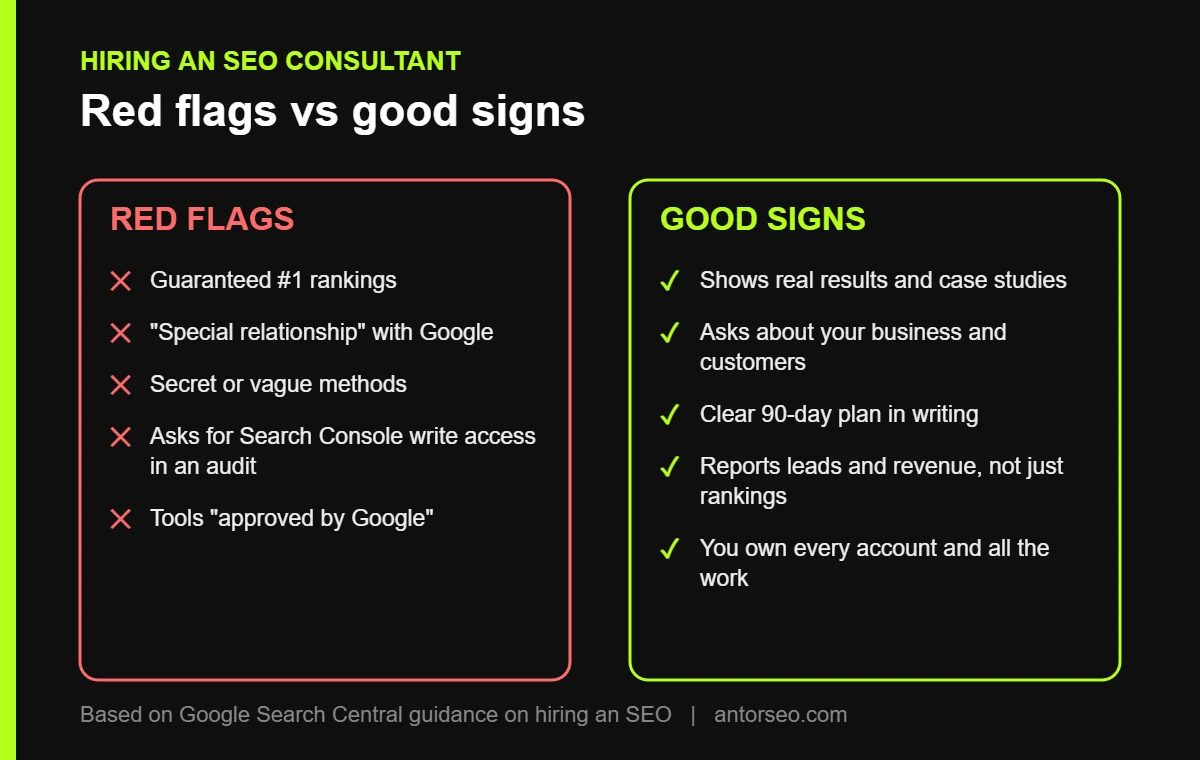
Google’s guide lists several warning signs. Here they are in one place:
| Red flag | Why it matters |
|---|---|
| Guaranteed #1 rankings | Google says no one can guarantee them |
| Claims of a “special relationship” with Google | No such thing exists |
| Unsolicited emails offering SEO | Google lists this as a warning sign |
| Secret or vague methods | You cannot judge risk you cannot see |
| Asking you to link to them | Google says you should never have to |
| Asking for write access to Search Console during an audit | Google recommends read-only access first |
| Tools “approved by Google” | Google does not approve or endorse third-party SEO tools |
How to Compare Proposals
When you have two or three proposals, compare them on the same points:
- Scope: exactly what work is included each month.
- Plan: the first 90 days, in writing.
- Reporting: what you will see and how often.
- Price and terms: monthly fee, minimum term and notice period.
- Proof: relevant case studies and references.
The cheapest proposal is rarely the best value, and the most expensive is not automatically the best. Choose the one with the clearest plan for your goals.
Before You Sign
- Start with an audit or short trial project if you are unsure.
- Give read-only access to Search Console and Analytics at first.
- Put goals, deliverables, reporting and account ownership in the agreement.
- Agree on how either side can end the work.
Frequently Asked Questions
How much does it cost to hire an SEO consultant?
It varies by scope and experience. Survey data puts consultants at about $3,250 a month on average, with many small businesses paying less. See our SEO cost guide for the full breakdown.
How long before I see results from an SEO consultant?
Google does not give a timeline. Technical fixes can show effects within weeks, while content and authority usually take several months. Ask each consultant for a realistic plan and how they will measure progress.
Should I hire a consultant or an agency?
A consultant gives you direct access to senior expertise. An agency gives you a larger team for content, development and links. The right choice depends on your budget and how much work you need done.
Is it safe to give an SEO access to my website?
Yes, if you control the access. Create a separate user account with only the permissions needed, and remove it when the work ends.
What should an SEO audit include?
A review of technical health, indexing, content quality, on-page SEO, links and, increasingly, AI search visibility, with fixes ranked by impact.
Looking for an SEO consultant who will answer all 12 questions openly? Learn how we work as a freelance SEO consultant, or start with a free SEO audit.