
The short answer: To optimize for Google AI Overviews, build pages that are crawlable, indexable, genuinely useful, clearly organized, factually supportable, and connected to a credible website. Google does not require a special AI schema, AI-only file, or secret GEO tactic. Its current guidance says that foundational SEO and people-first content remain the basis for appearing in AI features.
Google Search is no longer limited to a list of blue links. AI Overviews can summarize a complex question, combine information from multiple sources, and show links that help searchers investigate further. That change creates a new visibility opportunity for service businesses, SaaS companies, healthcare brands, e-commerce websites, and local businesses that can explain their subject clearly and demonstrate real expertise.
The opportunity is not to “hack” an AI answer. The opportunity is to become one of the most useful, reliable, and easy-to-understand sources available for the questions your ideal customers ask.
What are Google AI Overviews?
Google AI Overviews are AI-generated snapshots that appear for some searches when Google determines that a summarized answer adds value beyond the traditional results page. They provide an overview of important information and links to relevant websites for deeper exploration.
The feature is different from a normal featured snippet. A featured snippet generally extracts an answer from one page. An AI Overview may synthesize information from several pages and related searches. Google explains that its AI features can use a process called query fan-out, in which the system explores related subtopics and sources before producing a response.
For example, a search for “how to improve SaaS trial conversions” may lead Google to consider related questions about onboarding, activation metrics, product-led growth, pricing tests, and analytics. A page that answers only one narrow question may still be useful, but a well-structured resource that covers the topic and links to supporting evidence can provide more opportunities for relevance.
Google also uses retrieval-augmented generation, or RAG. In practical terms, the system retrieves relevant and current pages from the Search index and uses those sources to ground the response. This makes traditional SEO fundamentals especially important. If Google cannot crawl, index, understand, and trust your page, the page has little chance of becoming a supporting source.
Does Google AI Overviews SEO require a new ranking system?
No separate “AI Overview ranking checklist” has replaced SEO. Google’s official documentation says there are no additional technical requirements for appearing in AI Overviews or AI Mode. A page must be indexed and eligible to appear in Google Search with a snippet.
That does not mean every ranking page will be cited, or that every cited page will receive the same amount of traffic. AI-generated results vary by query, location, language, device, user context, and the specific search experience. Inclusion is never guaranteed.
The practical lesson is simple: GEO, AEO, and Google AI Overviews SEO should be treated as extensions of high-quality SEO, not as a replacement for it. Generative engine optimization tactics can help you make information easier to retrieve, interpret, verify, and cite. They cannot compensate for thin content, blocked crawling, poor site architecture, weak expertise, or unsupported claims.
The 10-step playbook to optimize for Google AI Overviews
1. Start with a real customer question, not a keyword list
The strongest AI Overview opportunities usually begin with a question that requires explanation, comparison, planning, or multiple steps. Instead of producing separate low-value pages for every wording variation, map one valuable topic to the needs of a real audience.
For a service business, the topic may be “how to choose an SEO consultant for a SaaS company.” The underlying questions could include what an audit covers, how long SEO takes, which metrics matter, what technical problems reduce visibility, and how results are reported. A comprehensive page can address these related needs without creating dozens of near-duplicate URLs.
Google specifically warns against creating large numbers of pages primarily to manipulate rankings or generative responses. Your editorial plan should therefore prioritize usefulness and coverage over page volume.
2. Give a direct answer before expanding the explanation
AI systems and human readers both benefit when the main answer is easy to locate. Open each major section with a concise answer, then explain the reasoning, process, examples, limitations, and evidence.
For instance, a section titled “Do I need special schema for AI Overviews?” should answer “No, Google says there is no special AI schema required,” before discussing structured data generally. This structure improves comprehension and gives search systems clear passages to associate with specific questions.
Use descriptive H2 and H3 headings, short paragraphs, informative tables, definitions, and meaningful examples. Avoid hiding essential information inside images, tabs, accordions, or JavaScript components that are difficult to process. Google recommends making important content available in textual form.
3. Publish non-commodity content based on first-hand experience
A generic article that repeats the same seven tips as every competitor is unlikely to establish a strong reason for selection. Add information that only an experienced practitioner or business can provide: original observations, anonymized workflows, before-and-after comparisons, implementation constraints, screenshots, client lessons, and clear explanations of what did not work.
Google’s generative AI optimization guidance emphasizes unique, valuable, people-first content and first-hand expertise. This is especially important for YMYL topics such as healthcare and finance, where unsupported advice can damage users and trust.
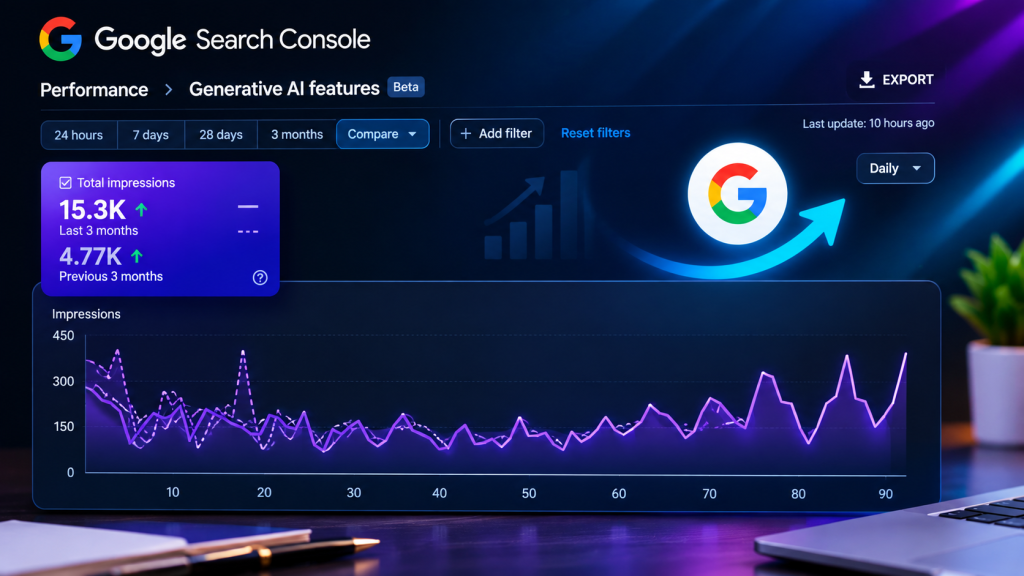
At Antor SEO, this is where our real client data speaks for itself. For example, in a recent campaign, we engineered a 104% increase in organic clicks and a 220% surge in Google AI Overview impressions within 90 days. It also reports that a three-month e-commerce project scaled daily organic traffic by 2.5x. Present these as documented client results, explain the timeframe and measurement source, and avoid implying that every future client will receive the same outcome.
4. Make claims easy to verify
To get cited in AI Overviews, write in a way that helps a system justify the answer. Define terms. State dates. Distinguish facts from recommendations. Link to primary documentation for platform policies and explain the source of your own data.
A strong claim has a clear subject, action, timeframe, and evidence. “Our SEO work increased traffic” is weak because it lacks context. “Organic clicks increased 104% during a six-month healthcare engagement, according to the client’s Google Search Console reporting” is more precise. If a result is confidential or based on a small sample, say so.
Do not manufacture citations, statistics, testimonials, or case studies. Do not quote an AI answer as proof. A citation should lead to a source that actually supports the statement on the page.
5. Improve crawlability, indexability, and internal links
A page cannot be a supporting link if Google cannot access or index it. Check that important URLs are not blocked by robots.txt, noindex directives, authentication, broken canonicals, or accidental server restrictions. Submit a sitemap and use Search Console’s URL Inspection tool to diagnose important pages.
Internal links help people and search systems discover related content. Link from high-authority pages to your new guide using descriptive, natural anchor text. Then link from the guide to the relevant service, case study, audit, or contact page. For this article, a natural conversion path is the Antor SEO homepage, where visitors can review your SEO, GEO, AEO, technical SEO, content, and visibility positioning and request a free SEO audit via WhatsApp.
Do not force the same exact-match anchor text repeatedly. Use context such as “technical SEO foundation,” “SEO strategy for SaaS,” “GEO and AEO visibility,” or “request an SEO audit.” Internal links should help the next decision a reader needs to make.
6. Use structured data accurately, but do not invent AI markup
Structured data can help Google understand eligible page types when it accurately reflects visible content. However, Google states that there is no special schema.org markup required for AI Overviews.
Use relevant standard markup where appropriate, such as Article, Organization, Person, BreadcrumbList, Product, LocalBusiness, or FAQPage, following Google’s requirements. Keep the structured data consistent with the visible page. Do not add fake reviews, hidden FAQ text, unsupported claims, or schema designed only to create a misleading appearance.
7. Build authority beyond your own website
Owned content establishes your expertise, but independent references can make your brand easier to validate. Earn relevant mentions through original research, expert commentary, partnerships, useful digital PR, industry contributions, and genuinely valuable resources. Do not buy irrelevant links or publish low-quality guest posts solely to manipulate rankings.
A 2025 research paper on generative engine optimization reported that the AI search systems tested showed a strong preference for earned media and third-party authoritative sources, although the study should be treated as research evidence rather than Google policy. The practical implication is to build a recognizable reputation across the web while keeping your own website as the clearest source of your services, methodology, and proof.
8. Add useful media and make it understandable
Relevant images, diagrams, charts, videos, and screenshots can clarify complex topics and create additional discovery opportunities. Add descriptive filenames, useful alt text, captions, and surrounding explanatory text. A screenshot of Search Console is more credible when the article explains what the reader is seeing, what period it covers, and what the metric means.
Media should support the page rather than replace the answer. Keep important facts in HTML text, and compress assets so page performance remains strong across mobile devices.
9. Measure visibility and business outcomes together
Do not judge an AI Overview strategy by a single screenshot or a keyword rank. Track impressions, clicks, click-through rate, conversions, qualified leads, assisted conversions, branded searches, and engagement by landing page.
Google says AI-feature traffic is included in the overall Web search type in Search Console. Depending on the available reporting in your property and market, isolate meaningful query and page patterns rather than assuming every impression came from an AI Overview. Combine Search Console with GA4 and your CRM so you can connect visibility to business value.
Create a baseline before publishing. Then review performance at 30, 60, and 90 days. Update pages when facts, product features, regulations, or Google guidance change. A useful generative search strategy is maintained, not completed once.
10. Improve the page after observing real queries
Search Console query data, customer questions, sales-call notes, support tickets, and internal-site searches reveal gaps that keyword tools often miss. Add a section when users repeatedly ask a related question. Rewrite confusing passages when impressions rise but qualified clicks remain low. Add proof when a claim is important but unsupported.
This feedback loop is more durable than trying to predict the exact wording an AI model will generate. Google’s systems can understand related concepts even when a page does not repeat an exact-match keyword.
What will not help you get cited in AI Overviews?
There is no guaranteed formula for citation. Adding the phrase “AI Overview” twenty times, creating an “AI.txt” file, stuffing unrelated entities into a page, or adding unsupported FAQ schema will not create sustainable visibility. Google explicitly says that special AI files and special schema are not required.
Likewise, publishing hundreds of lightly rewritten AI-generated pages can create a quality and spam risk. AI tools may assist with outlining, editing, or summarizing your own research, but the final content must be accurate, original, useful, and reviewed by someone who understands the subject.
Avoid promising clients a guaranteed AI Overview placement. A responsible SEO service can improve eligibility, relevance, clarity, authority, and measurement, but Google controls whether and when an AI Overview appears and which sources it displays.
A practical 90-day Google AI Overviews SEO plan
| Period | Priority | Deliverables | Measurement |
|---|---|---|---|
| Days 1–30 | Diagnose and prepare | Crawl/indexation review, Search Console baseline, topic and intent map, proof inventory, internal-link plan | Indexed pages, impressions, technical issues, baseline conversions |
| Days 31–60 | Publish and strengthen | One comprehensive pillar guide, supporting pages, author/about signals, original evidence, accurate structured data, relevant outreach | Query coverage, clicks, CTR, referring domains, engagement |
| Days 61–90 | Improve and scale | Refresh weak sections, expand proven subtopics, test titles and CTAs, connect GA4 and CRM reporting | Qualified leads, assisted conversions, page-level growth, repeat visibility |
The plan should be adapted to the site’s authority, competition, technical condition, and commercial goals. A small business may benefit more from one excellent service page and a strong case study than from a large blog archive.
Final takeaway
The best answer to “how to optimize for Google AI Overviews” is not to abandon SEO for a new acronym. Build a technically accessible website, publish original and reliable content, answer questions directly, support claims with evidence, earn credible mentions, connect related pages with useful internal links, and measure the path from search visibility to revenue.
That is the foundation of Google AI Overviews SEO and the most defensible set of generative engine optimization tactics available in 2026. If you want a strategy based on your current technical issues, content gaps, and Search Console data, visit our website or request a free SEO audit on WhatsApp. The goal is not merely to appear in an AI-generated summary. The goal is to become the trusted source that earns the click and the customer.
Want us to audit your website’s AI search visibility? Explore our SEO Pricing & Growth Plans or Request a Free Technical Audit.
References
[1] AI features and your website — Google Search Central
[2] Optimizing your website for generative AI features on Google Search — Google Search Central
[3] AI Overviews — Google Search
[4] Generative Engine Optimization: How to Dominate AI Search — Chen et al.