
Key Takeaways
- Dental SEO is local SEO plus health content. Patients search for a dentist near them, then judge the practice on reviews, photos and how clearly the site explains treatments.
- Set up Google Business Profile correctly: one profile for the practice, and separate profiles only for public-facing dentists, following Google’s practitioner rules.
- Build one strong page per treatment, such as implants, Invisalign and emergency care, instead of one page that lists everything.
- Never confirm a patient relationship or treatment details when replying to reviews. US dental practices have paid HIPAA settlements for doing exactly that.
- Dental content is health content. Have a licensed dentist write or review it and show who did.
Dental SEO is the work of getting a dental practice found by patients searching Google, Google Maps and AI assistants. It combines two things most generic SEO advice treats separately: local SEO, because patients want a dentist nearby, and health content standards, because dental advice affects people’s health and money.
This guide covers the setup that matters most for dentists in 2026, from Google Business Profile rules to treatment pages, reviews and the privacy mistakes that can cost a practice far more than lost rankings.
Why Dental SEO Is Different
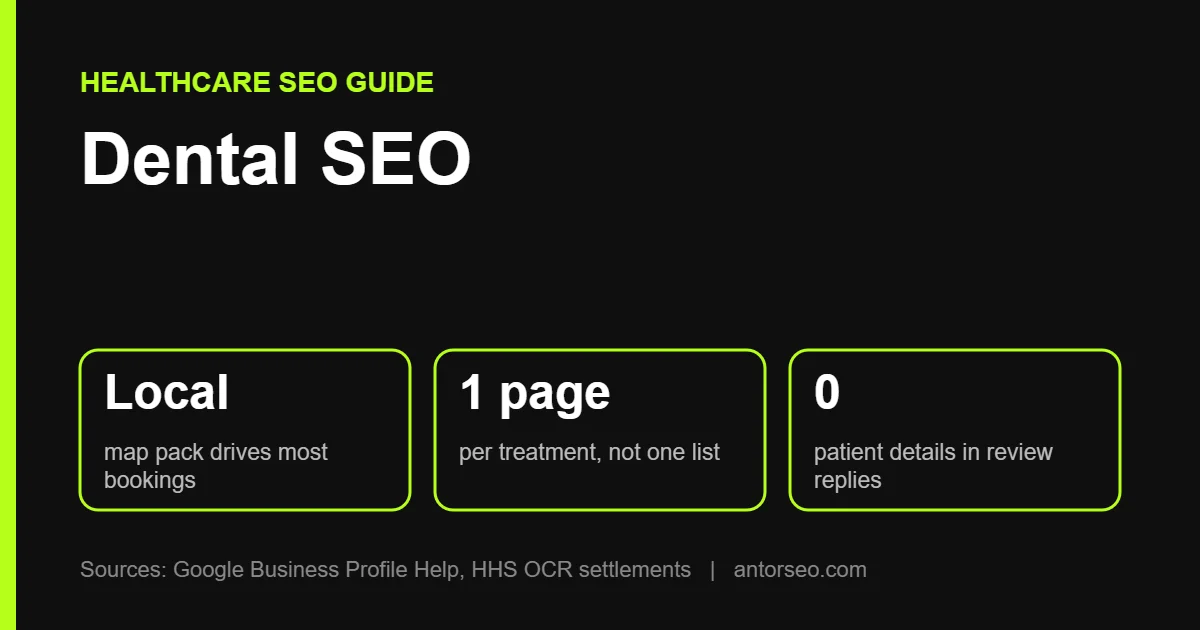
Most dental searches have local intent. “Dentist near me,” “emergency dentist open now” and “Invisalign in [city]” all show a map pack before regular results. Google says local results are based mainly on relevance, distance and prominence, so the practice’s Business Profile, reviews and local reputation carry a lot of weight.
At the same time, a page about root canals or implants is health content. Google’s quality guidelines treat topics that affect health as “Your Money or Your Life” content and expect more trust and expertise. That is why dental sites need real dentist authorship, not generic marketing copy. Our guide to E-E-A-T explains what that looks like.
1. Set Up Google Business Profile Correctly
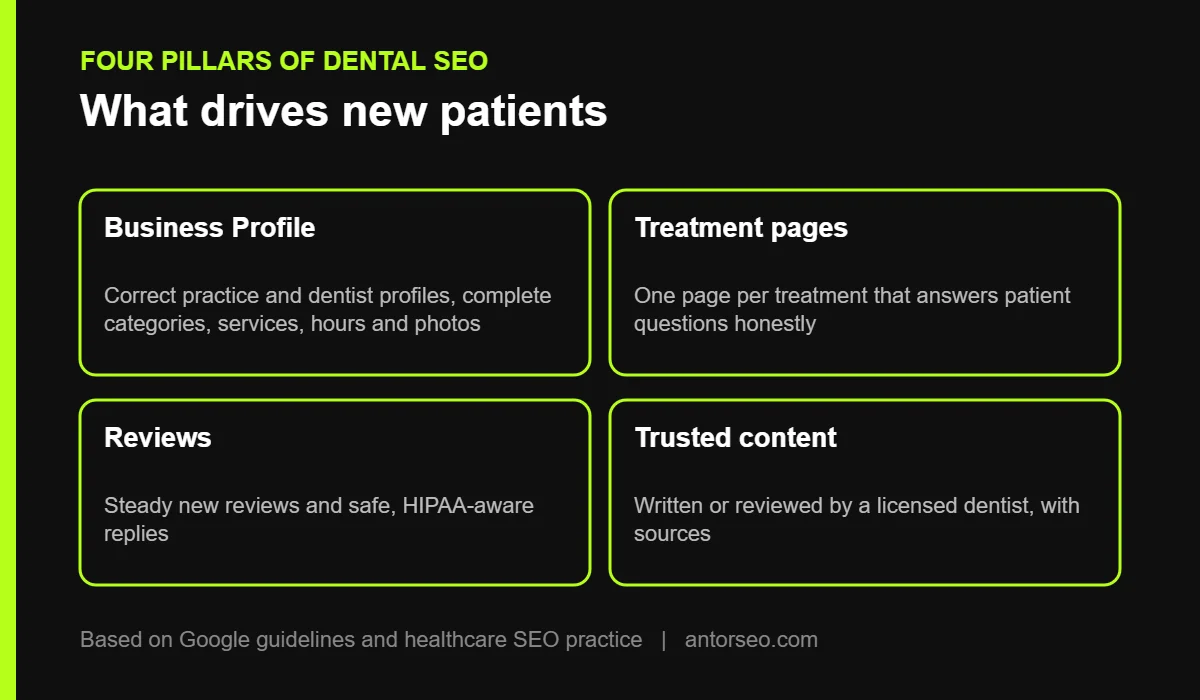
Your Business Profile is often the first thing a patient sees. Google’s guidelines for representing your business include specific rules for practitioners:
- The practice gets its own profile for each location.
- Individual dentists can have their own profiles if they are public-facing and can be contacted at the verified location during stated hours. Support staff should not have profiles.
- Each dentist’s profile uses only the dentist’s name, not the practice name. Titles such as “Dr.” or “DDS” are allowed.
- Do not create extra profiles for different specialties of the same dentist.
- Use your real practice name. Adding words like “Best Cosmetic Dentist” to the name is not allowed and can get the profile suspended.
Then complete every field: primary category (Dentist, or a specialty such as Orthodontist where it fits), secondary categories, services, hours, holiday hours, photos of the office and team, and booking links. Our Google Business Profile optimization guide walks through each field.
2. Build One Page for Each Treatment
Patients search for specific treatments, not “dental services.” A single services page that lists 20 treatments in bullet points cannot rank for all of them.
Create a dedicated page for each important service:
| Treatment page | What it should answer |
|---|---|
| Dental implants | Who is a candidate, steps, timeline, recovery, cost factors |
| Invisalign or clear aligners | How it works, treatment length, aftercare, who it suits |
| Emergency dentist | Hours, what counts as an emergency, how to get seen fast |
| Teeth whitening | Options, how long results last, sensitivity |
| Root canal | Symptoms, what happens, pain and recovery |
| Children’s dentistry | First visit age, what to expect, how you make kids comfortable |
Each page should show real photos (with patient consent), name the dentist who performs the treatment, explain costs honestly (even as ranges or factors), and answer the questions patients ask at the front desk.
3. Get More Reviews, and Reply Safely
Google says more reviews and positive ratings can improve local ranking. For dentists, reviews also do most of the convincing. Ask every satisfied patient at checkout, by text or by email, and make it easy with a direct link. Our guide on how to get Google reviews covers ethical ways to do it.
Replying to reviews is good practice, but dental practices in the US must be careful. Under HIPAA, a provider cannot reveal patient information in a public reply. The US Department of Health and Human Services settled with a Texas practice for $10,000 in 2019 and with a California practice for $23,000 after they disclosed patient names and treatment details while responding to Yelp reviews.
Safe review replies:
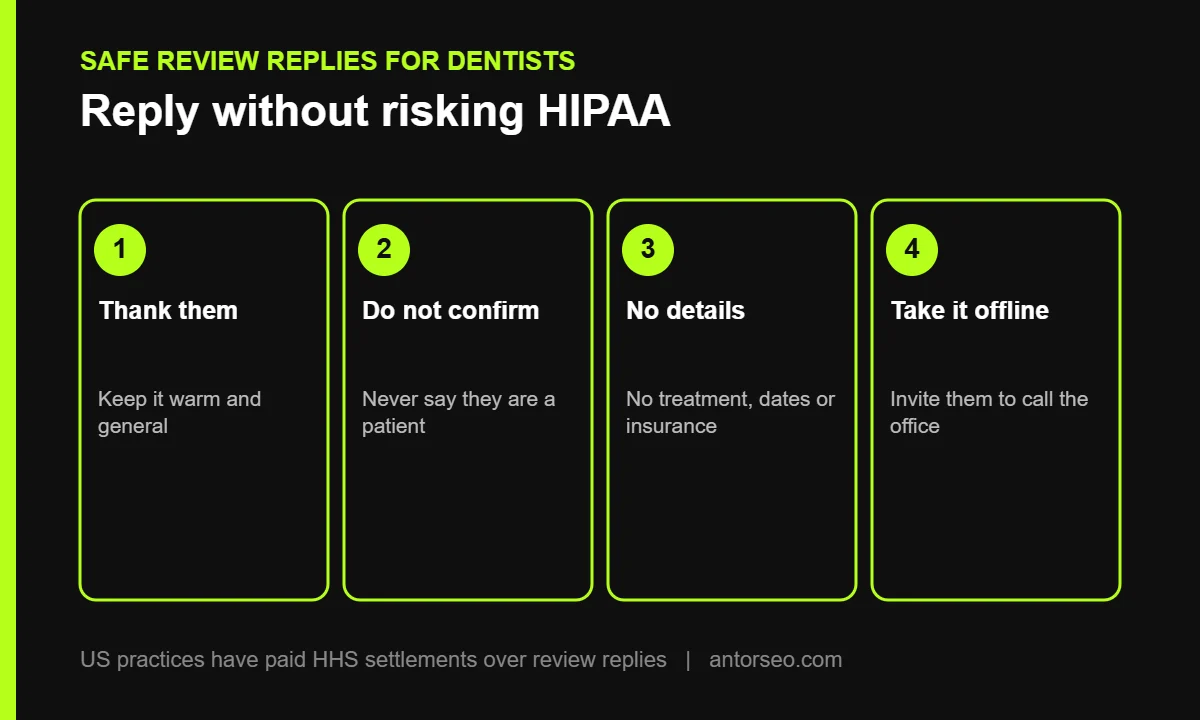
- Thank the reviewer without confirming they are a patient.
- Never mention treatments, appointments, insurance or dates.
- For complaints, invite the person to call the office privately.
4. Write Trustworthy Dental Content
Blog posts and guides help a practice rank for questions like “how long do dental implants last” or “is teeth whitening safe.” To work, this content must be accurate and clearly come from qualified people.
- Have a licensed dentist write or review every clinical article, and show their name, qualifications and a short bio.
- Cite reliable sources such as professional dental associations and published research when you state facts.
- Avoid promises such as “pain-free” or “guaranteed results.”
- Update articles when guidance changes.
5. Get the Local Basics Right
- Consistent NAP. Keep your name, address and phone number the same on your site, Business Profile and directories. See our guide to local citations.
- Dental directories. Claim listings on platforms patients use, such as Healthgrades, Zocdoc and your national dental association’s find-a-dentist directory.
- Location pages. If you have several offices, give each one its own page with address, hours, team and directions.
- Schema markup. Schema.org has a specific Dentist type. Add it with your address, hours and phone, and make sure it matches the visible page. Our schema markup guide shows how.
6. Make the Website Easy to Book From
Rankings only matter if visitors book. Put your phone number and booking button at the top of every page, make the site fast on mobile, list insurance plans you accept, and show new patient offers clearly. A fast site also helps search, as we explain in our Core Web Vitals guide.
Dental SEO and AI Search
Patients now ask AI assistants questions such as “which dentist near me is good for nervous patients.” These tools pull from Business Profiles, reviews, directories and practice websites. Complete profiles, consistent details and clear treatment pages make it easier for them to describe your practice accurately. Our guide to Google AI Mode SEO covers the Google side.
How to Measure Dental SEO
Track the numbers that turn into patients:
- Calls and direction requests from your Business Profile.
- Online bookings and contact form submissions from organic search, tracked as conversions in Google Analytics.
- Rankings in the map pack for your main treatments in your area.
- Impressions and clicks for treatment pages in Google Search Console.
- New reviews per month and your average rating.
Frequently Asked Questions
How long does dental SEO take to work?
Business Profile and review improvements can show results within weeks. Ranking new treatment pages in competitive cities usually takes several months of steady work.
Should each dentist in our practice have a Business Profile?
Google allows it for public-facing dentists who can be contacted at the location during stated hours. The practice should also have its own profile.
Can we reply to negative reviews?
Yes, but in the US you must not confirm the reviewer is a patient or mention any treatment details. Keep replies general and move the conversation offline.
What pages should a dental website have?
At minimum: a home page, one page per main treatment, a page for each location, a team page with dentist bios, a new patients page, and a contact page with booking.
Is dental SEO worth it compared with ads?
Ads bring patients immediately but stop when you stop paying. SEO builds a steady flow over time. Many practices use both. Our SEO cost guide explains typical budgets.
Run a dental or medical practice? Our healthcare SEO service covers dental practices, or you can start with a free SEO audit.