
Key Takeaways
- Search intent is the reason behind a search: what the person wants to know, do or find.
- Google’s own ranking explainer says it starts by working out the intent behind a query, before it judges relevance or quality.
- Google’s quality rater guidelines group intent into Know, Do, Website and Visit-in-person queries. Many queries have more than one.
- The fastest way to read intent is to look at what already ranks: the page types, formats and angles Google shows for that query.
- A great page in the wrong format will struggle. Match the type of page first, then make it better than what ranks.
You can write the most detailed article on a topic and still not rank, because the people searching wanted something else. That gap is a search intent problem, and it is one of the most common reasons good content fails.
This guide explains what search intent is, how Google thinks about it, how to read it from the search results, and how to shape a page so it matches what searchers want.
What Is Search Intent?
Search intent, also called user intent, is the goal behind a search. Someone typing “running shoes” may want to buy a pair, compare brands or find a store nearby. The words are the same, but the right page is different for each goal.
Google puts intent first. Its explainer on how Search ranks results says the first step is understanding the meaning and intent behind a query. It also gives examples: words like “cooking” or “pictures” suggest recipes or images may fit best, and a search for “pizza” can show nearby businesses that deliver.
The Types of Search Intent
Many SEO guides use four labels: informational, navigational, commercial and transactional. Google’s quality rater guidelines use their own groups. Both are useful, and they map closely.
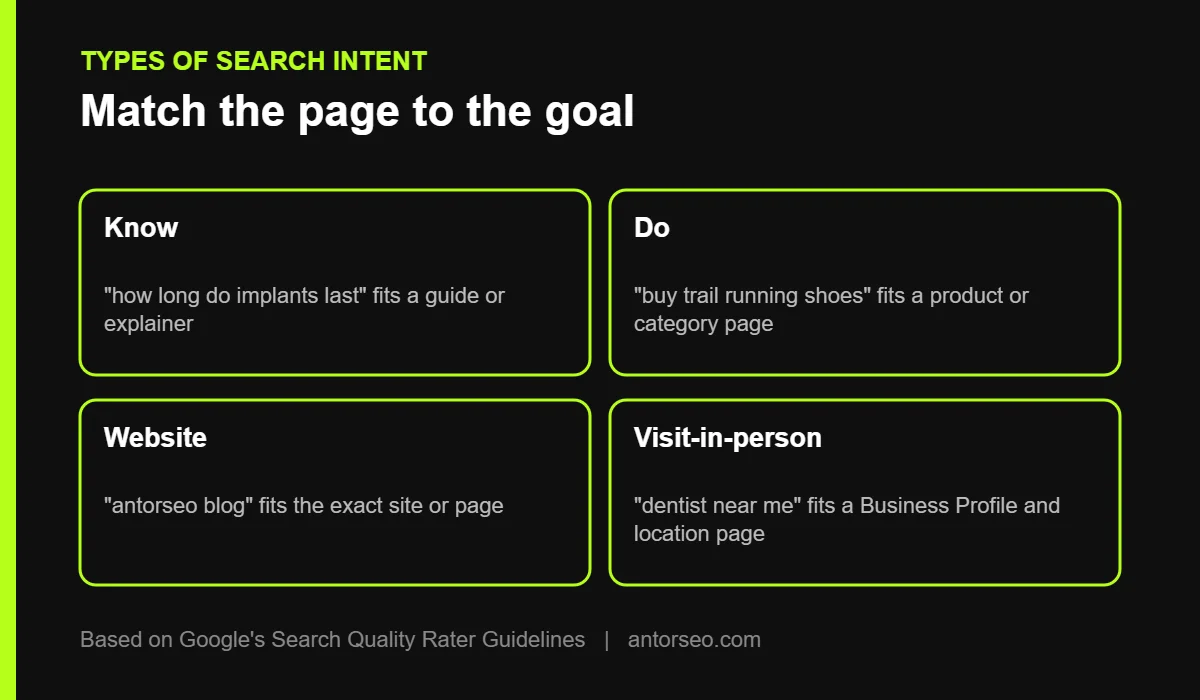
| Google rater category | Common SEO label | Example search | Page type that usually fits |
|---|---|---|---|
| Know (and Know Simple) | Informational | how long do dental implants last | Guide, explainer, FAQ answer |
| Do | Transactional or commercial | buy trail running shoes | Product page, category page, sign-up page |
| Website | Navigational | antorseo blog | The exact site or page |
| Visit-in-person | Local | dentist near me | Business Profile and location page |
Commercial investigation sits between Know and Do. Searches like “best CRM for small business” or “Ahrefs vs Semrush” come from people comparing options before they buy. Comparison pages and reviews fit these, as in our Ahrefs vs Semrush comparison.
Many queries have more than one intent. “Apple store” could mean the website, the nearest shop or opening hours. Google often shows a mix of result types for these searches.
How to Find Search Intent for Any Keyword
The search results are the best guide, because they show what Google has learned people want. Search the keyword in a private window from the country you target and look at:
- Page types. Are the top results blog posts, product pages, category pages, tools or local listings?
- Content format. Are they how-to guides, lists, comparisons, reviews or definitions?
- Angle. Do titles focus on “for beginners,” “in 2026,” “free,” “cheap” or “best”?
- SERP features. A map pack suggests local intent. Shopping results suggest buying intent. Videos suggest people want to watch a demo. An AI Overview suggests a quick answer is expected.
- People also ask. These questions show the follow-ups searchers have, which your page should also answer.
Use this alongside your keyword research. A keyword with good volume is only worth targeting if you can create the type of page that matches its intent.
How to Match Search Intent
Match the Page Type First
If the top ten results are product category pages, a blog post will struggle to rank, no matter how good it is. If they are guides, a sales page will struggle. Choose the right type of page before you write anything.
Match the Format and Depth
If results are short definitions, a 4,000-word guide may be more than people want. If results are step-by-step tutorials, a short overview will fall short. Look at what the best result covers and plan to cover it better and more clearly.
Answer the Main Question Early
Put the direct answer near the top, then add detail. This helps impatient readers and makes your page a clear candidate for featured snippets and AI answers. We cover the AI side in Google AI Mode SEO.
Cover the Next Questions
Searchers rarely stop at one question. Use “People also ask” and your own customer questions to add the follow-ups to the same page, or link to pages that answer them.
Write Titles and Descriptions That Confirm the Intent
Your title tag and meta description should show searchers at a glance that your page is the type they want: a guide, a comparison, a price list or a local service.
Search Intent and Keyword Cannibalization
When two of your pages target the same intent, they compete with each other. When one page tries to serve two different intents, it often serves neither well. A simple rule helps: one primary intent per page. A service page targets “SEO consultant” (Do and Visit-in-person), while a blog post targets “how much does SEO cost” (Know and commercial). See how this works in our SEO cost guide, which supports our service pages instead of competing with them.
Intent Across the Funnel
Intent maps closely to the marketing funnel:
- Know searches bring people learning about a problem.
- Commercial searches bring people comparing solutions.
- Do searches bring people ready to act.
Businesses that only publish Know content get traffic but few leads. Our guide to bottom-of-funnel content explains how to build pages for people who are ready to buy.
Search Intent Changes Over Time
Intent is not fixed. Google’s rater guidelines note that query meanings can change over time. A product name may mean a launch announcement one month and reviews the next. Recheck the results for your most important keywords every few months, and update pages when the type of result Google shows changes.
Frequently Asked Questions
What are the four types of search intent?
The common labels are informational, navigational, commercial and transactional. Google’s rater guidelines use Know, Do, Website and Visit-in-person, plus queries with multiple intents.
How do I find the search intent of a keyword?
Search it and study the top results: their page types, formats, angles and SERP features. They show what Google has learned searchers want.
Is search intent a ranking factor?
Google does not call it a single ranking factor, but its ranking explainer says understanding the meaning and intent of a query comes first. Pages that do not match intent rarely rank well.
Can one page target more than one intent?
It can for closely related intents, such as learning and comparing. For very different intents, such as learning and buying, separate pages usually work better.
Why does my content not rank even though it is detailed?
Often because it is the wrong type of page for the query. Compare your page with the top results and check whether you match their type and format.
Want to know if your pages match the intent of the keywords you target? Our free SEO audit checks content against search intent, and our on-page SEO guide covers the rest.