
Key Takeaways
- E-E-A-T stands for Experience, Expertise, Authoritativeness, and Trustworthiness. Trust matters most.
- It is not a single direct ranking factor. It is a concept from Google’s Search Quality Rater Guidelines.
- Topics that affect health, money, or safety (YMYL) face a higher bar.
- AI search tools publish no E-E-A-T checklist, but clear authors, original insight, and consistent brand mentions appear to help.
- You build E-E-A-T by showing real people, real experience, and real proof on the page.
E-E-A-T stands for Experience, Expertise, Authoritativeness, and Trustworthiness. It is the set of qualities Google’s quality raters use to judge whether a page, and the people behind it, can be relied on.
If you searched “what is eeat” and found vague answers, this guide is for you. You will learn what each letter means, whether it is a ranking factor, how Google’s guidelines treat it, and how it connects to AI search. You will also get ten practical steps and a checklist to make EEAT SEO work on your own site. Along the way, you will see what Google has confirmed and what is only industry observation.
What Is E-E-A-T?
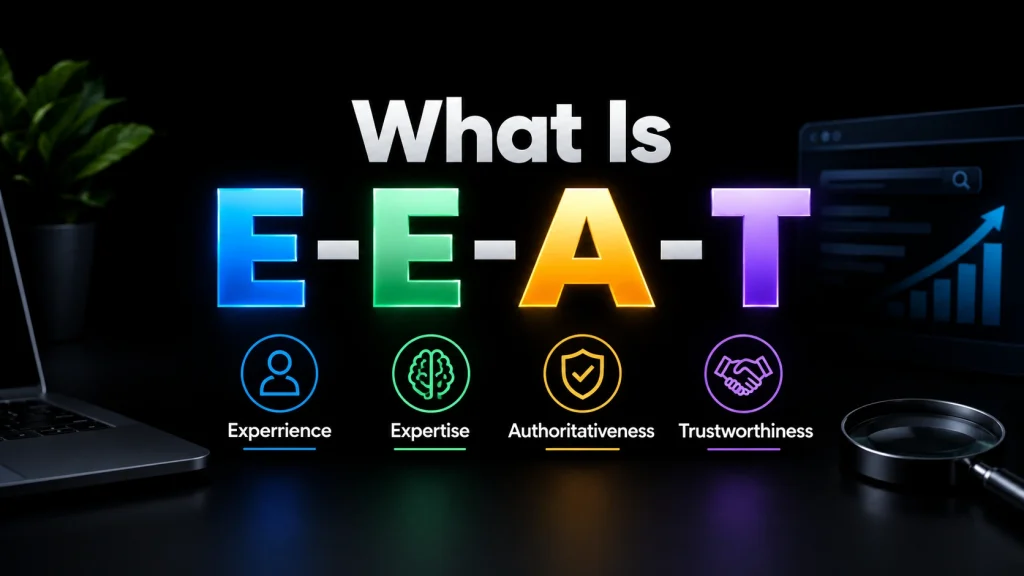
E-E-A-T is the framework Google uses to describe what a trustworthy, helpful page looks like. It began as E-A-T. Google added the extra “E” for Experience in December 2022, when it updated its Search Quality Rater Guidelines.
Trust is the center of the framework. Google’s guidelines call trust the most important part. A page can look expert and still fail if it is not honest, accurate, or safe. Experience, Expertise, and Authoritativeness are the ways a page earns that trust.
Experience is first-hand, real-life involvement with the topic. A standing desk review from someone who has used the desk for six months, with original photos, is more useful than a rewritten spec sheet.
Expertise is the knowledge or skill of the person creating the content. A guide to small business tax deductions written by a licensed accountant is a good example. For everyday topics, practical know-how can count too.
Authoritativeness is being recognized as a go-to source by others in your field. A local roofing company that trade groups and local news cite regularly carries more weight than an unknown blog.
Trustworthiness covers accuracy, honesty, transparency, and safety. An online store with clear returns, real contact details, and secure checkout is easier to trust than one with none of these.
Is E-E-A-T a Ranking Factor?
E-E-A-T is not a single, direct ranking factor. There is no E-E-A-T score attached to your page, and no plugin can measure one. It is a concept from the Search Quality Rater Guidelines, the document Google gives to human evaluators.
What Google has confirmed: its helpful content guidance says its automated systems use many signals to identify content that shows good E-E-A-T, and that trust is the most important part. Raters do not rank pages. Their ratings do not directly change where a page appears. Google uses their feedback to check whether its ranking systems are producing good results.
What is industry observation: many SEOs see sites with clear authorship, strong reputations, and original content hold up better during core updates, especially in health and finance. That pattern fits Google’s stated goals, but no one outside Google can prove exactly which signals are involved.
So treat EEAT SEO as a quality target, not a checkbox.
Google EEAT Guidelines Explained
The Search Quality Rater Guidelines are a public PDF that Google gives to thousands of contract raters worldwide. Raters review real search results and judge how helpful they are and how high the page quality is. Google updates the document from time to time, so read the current version instead of relying on old summaries.
When rating page quality, raters look at who is responsible for the site, who created the content, what the page is for, and how others regard the site. They often research the site off the page too, such as reading independent reviews and looking for a clear About page and contact details. Google’s own helpful content guidance turns this into three questions: Who created the content, How was it created, and Why was it created.
YMYL stands for “Your Money or Your Life.” These are topics that could significantly affect a person’s health, financial stability, or safety, or the wellbeing of society. Medical advice, tax and investment guidance, legal information, and civic or election information all fall here.
YMYL topics face a higher bar because bad information can cause real harm. A blog post about hiking snacks and a page about medication dosage are not judged the same way. For the second, raters expect clear expertise, a strong reputation, and accurate, well-sourced content. E-E-A-T applies to every topic, but the proof required rises with the risk.
Why EEAT SEO Matters for Rankings and Visibility
EEAT SEO matters because it lines your site up with what Google says it wants to reward. Here is where it shows up.
Trust
Trust decides whether people act on what they read. Picture two clinic pages about the same treatment. One is reviewed by a named physician with a visible license and a profile page. The other has no author and no sources. Which one would you send to a family member? Google’s guidelines treat low trust as a serious quality problem.
Content quality
Content quality is where experience and expertise show up. Generic summaries of the top ten results add nothing new. Pages with original examples, data, and expert input give readers and search systems a reason to prefer them.
Helpful content systems
Google’s helpful content system was built to reward people-first content. Google has said it now works through its core ranking systems, rather than as one separate signal, since the March 2024 core update. Its published self-assessment questions ask about first-hand experience, expertise, and who is behind the content, which is E-E-A-T in plain language.
Brand signals
Brand signals shape how raters judge reputation. Google has not said brand mentions are a direct ranking factor. Still, people search for brands they know, click names they trust, and share them. A recognizable brand also gives AI tools a clearer entity to reference.
Brand signals
Brand signals shape how raters judge reputation. Google has not said brand mentions are a direct ranking factor. Still, people search for brands they know, click names they trust, and share them. A recognizable brand also gives AI tools a clearer entity to reference.
E-E-A-T and AI Search

EEAT and AI search overlap more than most people expect, but you need to be careful about what is actually known.
What Google has said: AI Overviews and AI Mode are Google Search features, and the same SEO fundamentals apply. To appear as a supporting link, a page must be indexed and eligible to show with a snippet. Google says no special markup or extra file is required.
What is not published: ChatGPT search, Perplexity, and Gemini retrieve web pages and cite them, but none has published a full list of how it picks sources. Anything more specific is observation or testing.
What SEOs commonly observe: sources seem to get cited more often when they show these four traits.
- Clear authorship. A named person with visible credentials makes a claim easier to attribute and trust.
- Original insight. First-hand experience, unique data, and a clear point of view give an AI answer something a generic page cannot.
- Entity clarity. Your brand, people, and services are described the same way across your site and profiles, so systems can tell who you are.
- Consistent brand mentions. Some third-party studies link frequent brand mentions across the web with AI visibility. That is correlation, not proof of cause.
This is where GEO and AEO come in. Generative Engine Optimization and Answer Engine Optimization aim to make your content easy for AI systems to find, understand, and cite. In practice, good SEO with strong E-E-A-T covers most of it: answer-first writing, clear headings, cited sources, and named experts. No one can guarantee a citation.
How to Improve E-E-A-T
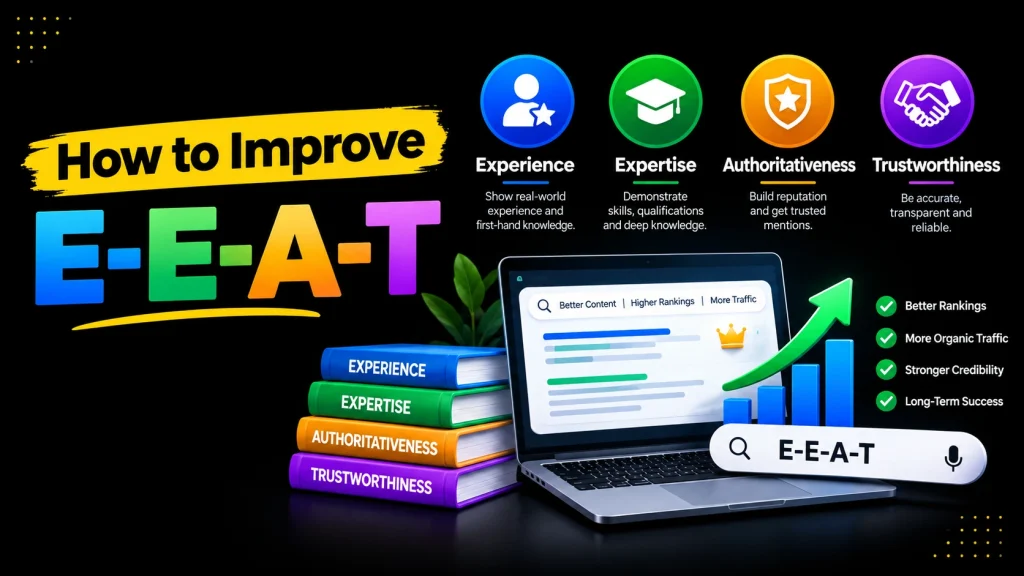
Here is how to improve EEAT in ten steps. Start with the pages that matter most to revenue, and with any YMYL pages.
1. Add author bios with real credentials
Show who wrote or reviewed each page. Include a name, role, relevant credentials, and a link to a profile. A dental article might say “Reviewed by Dr. [Name], licensed dentist,” with a link to a professional profile.
2. Share first-hand experience and original data
Add what only you can. Screenshots, process notes, test results, or your own survey data all work, and a well-written case study is a good format for them. Never publish numbers you cannot back up.
3. Cite credible sources
Link claims to primary sources such as government sites, peer-reviewed studies, and official documentation. A nutrition post should link to the study itself, not to another blog’s summary of it.
4. Make your About and Contact pages clear
Say who runs the business, what you do, where you operate, and how to reach you. A strong About page has real names, photos, roles, and a working contact route.
5. Show genuine reviews and testimonials
Collect reviews on independent platforms and display real testimonials with context. A local business can show its Google reviews summary and link to the profile. Never fake or buy reviews.
6. Earn digital PR and brand mentions
Get referenced by respected sites in your field. A guest quote in an industry publication, a podcast appearance, or a local news feature that links to your site all count. Quality beats volume.
7. Add Person and Organization schema
Structured data, also called schema markup, helps search engines understand who you are. Add Organization markup to your site (see Google’s documentation) and Person markup to author pages, with links to official profiles using sameAs. Google has not said schema boosts E-E-A-T directly, but it removes guesswork. The markup must match what visitors can see.
8. Keep content accurate and updated
Review key pages on a schedule, ideally as part of a regular SEO audit. A tax guide should be revised whenever the rules change. Show an updated date only when you have truly revised the page.
9. Secure your site and publish clear policies
Use HTTPS and publish privacy, terms, and refund policies. A health site can add an editorial policy page explaining how articles are written, sourced, and reviewed.
10. Keep Google Business Profile and LinkedIn consistent
Use the same business name, address, and description across your site, Google Business Profile, and LinkedIn where they apply. A consultant’s LinkedIn headline should match the bio on their site.
E-E-A-T Checklist
Use this EEAT SEO checklist to audit any page. Answer yes or no to each item.
- Does the page name an author or reviewer?
- Is that person’s relevant experience or credential visible?
- Does the page include first-hand examples or original data?
- Are key claims linked to credible sources?
- Is the information accurate and recently reviewed?
- Can visitors easily find About, Contact, and policy pages?
- Are genuine reviews or proof of reputation visible?
- Is the site secure, with no misleading ads or pop-ups?
- Are brand, author, and business details consistent across the web?
- Does the page match search intent without overpromising?
Any “no” is your next fix.
Common E-E-A-T Mistakes
These are the most common EEAT SEO mistakes I would expect to see in an audit.
- Anonymous content. Publishing with no author or reviewer, especially on YMYL topics.
- Fake or inflated credentials. Invented bios, stock photos posing as authors, or claims you cannot prove. Trust breaks fast once someone checks.
- Treating E-E-A-T like a label. A “medically reviewed” badge with no real review adds risk, not trust.
- Unchecked AI or copied content. Summaries of what already ranks, published without expert review or fact-checking.
- Ignoring off-site reputation. Strong pages cannot fully make up for poor reviews and no mentions elsewhere.
FAQs
-
What is EEAT in SEO?
EEAT stands for Experience, Expertise, Authoritativeness, and Trustworthiness. It is a framework from Google’s Search Quality Rater Guidelines that describes what reliable, helpful content looks like. It is not a score or a direct ranking factor, but Google’s systems aim to reward content that shows these qualities.
-
What are the Google EEAT guidelines?
The Google EEAT guidelines sit inside the Search Quality Rater Guidelines, a public document used by human raters. It explains how raters judge page quality, who is responsible for content, and site reputation. It also sets a higher bar for YMYL topics such as health and finance. Raters do not directly change rankings.
-
How do I improve EEAT on my website?
Start with visible authors and credentials, then add first-hand experience, original data, and credible citations. Make your About and Contact pages clear, collect genuine reviews, keep content updated, and earn mentions from reputable sites. Work on your most important and YMYL pages first, since those face the most scrutiny.
-
Does EEAT matter for AI search like ChatGPT and Perplexity?
Likely yes, though nothing is guaranteed. These tools do not publish exact source selection rules. Clear authorship, original insight, consistent brand mentions, and well-cited content are commonly observed among cited sources. They also match what strong SEO already requires, so the work helps in both places.
-
Is EEAT a ranking factor?
Not directly. Google has said E-E-A-T is not a single ranking factor and there is no E-E-A-T score. Its systems use many signals that tend to match content with strong E-E-A-T, and trust is the most important. Treat it as a quality goal, not a metric to chase.
The Bottom Line
EEAT SEO comes down to one idea: show real people, real experience, and real proof, and make it easy to verify. Google does not score it directly, but its guidelines and helpful content guidance point the same way, and AI search tools appear to favor the same signals. Start with your most important pages, fix authorship and accuracy, then build your reputation off the page too.
If you want a second pair of eyes, Nayem Khan helps businesses build E-E-A-T for both Google and AI search, from author and entity clarity to content that earns trust.