
Ranking #1 on Google used to guarantee something. In 2026, it guarantees almost nothing if the query that would have sent someone to your page now gets answered inside ChatGPT, Perplexity, or an AI Overview before a results page ever loads. The click you used to earn gets absorbed into somebody else’s synthesized paragraph instead. Zero-click search isn’t new, but generative answer engines have turned it from an occasional annoyance into the default outcome for a huge share of informational, comparison, and even transactional queries.
The ten blue links aren’t dead. They’re just no longer where the decision gets made. That decision now happens inside a paragraph with a handful of citations underneath it, and getting into that paragraph is the actual game. That’s what Generative Engine Optimization, GEO, is for, alongside its closely related discipline, Answer Engine Optimization (AEO): getting your brand into the answer itself, not just onto a results page beneath it.
Direct answer: How do you rank in ChatGPT Search and Perplexity? Structure your content as self-contained, direct answers an AI system can extract without interpretation, back every claim with consistent entity data (schema markup, Wikidata and Wikipedia links, uniform naming across every platform you appear on), and build third-party consensus through mentions on Reddit, G2, Trustpilot, and industry roundups. None of it matters if OAI-SearchBot, Claude-SearchBot, and PerplexityBot can’t reach the page in the first place, so technical crawl access comes before any of the rest.
How AI Search Engines Actually Decide What to Cite
Every one of these products runs on some version of Retrieval-Augmented Generation, RAG for short. When a query needs current or specific information, the system doesn’t answer purely from what it learned during training. It retrieves first: a query goes out against a live web index or a fresh crawl, a set of candidate pages comes back, and only then does the model draft an answer, attaching citations to the specific sources it decided to use.
The 3 platforms build that retrieval layer differently. ChatGPT Search leans heavily on Bing for live retrieval; OpenAI has acknowledged working with third-party search providers without spelling out the exact split, but independent testing keeps finding the same pattern, ChatGPT’s search results tracking Bing’s index closely. Being in Bing’s index isn’t a footnote for this channel, it’s closer to a prerequisite: a page Bing hasn’t seen is largely a page ChatGPT can’t cite, no matter how strong the writing is.
Perplexity runs its own hybrid index, layered on top of Brave Search plus proprietary crawling, refreshed often enough that recency carries real weight.Claude’s web search runs as an explicit, on-demand tool call: Claude issues search queries, gets back a ranked set of results, opens the pages worth opening in full, and only then writes an answer with citations tied to individual sentences.
Once a set of candidate pages exists, four things decide who actually gets quoted:
- Confidence scoring. The passage has to unambiguously answer the specific question asked, not just sit in the same general topic area.
- Entity resolution. The system needs to be certain which brand, person, or organization a page is actually about. Structured data and consistent naming remove the ambiguity that otherwise gets a page skipped.
- Information gain. If ten retrieved pages say the same thing, the system tends to cite the one or two that add something the others don’t, an original number, a named source, a specific detail, not all ten.
- Freshness. For anything time-sensitive, a page from last month beats a more authoritative page from three years ago.
This is a different game from classic SEO, not an extension of it:
| Factor | Traditional Google SEO | Generative Engine Optimization |
|---|---|---|
| Core unit of relevance | Keywords and phrase matching | Entities and their relationships |
| Trust signal | Backlink volume and anchor text | Consensus: how consistently independent sources describe you |
| Content depth | Word count and topical comprehensiveness | Information density: distinct, checkable facts per paragraph |
| Output format | A ranked list of ten links | One synthesized answer with a handful of citations |
| Success metric | Position, rank 1 through 10 | Citation frequency, your share of relevant answers |
| Off-page requirement | Links pointing at your domain | Mentions of your brand, linked or not, across forums, reviews, and roundups |
Backlinks haven’t stopped mattering. They still correlate loosely with how often a domain gets cited. They’ve simply stopped being the primary lever: a domain with modest backlink volume and clean entity data regularly outcites a domain with strong traditional rankings and none of the entity work done.
The 4-Pillar GEO Blueprint
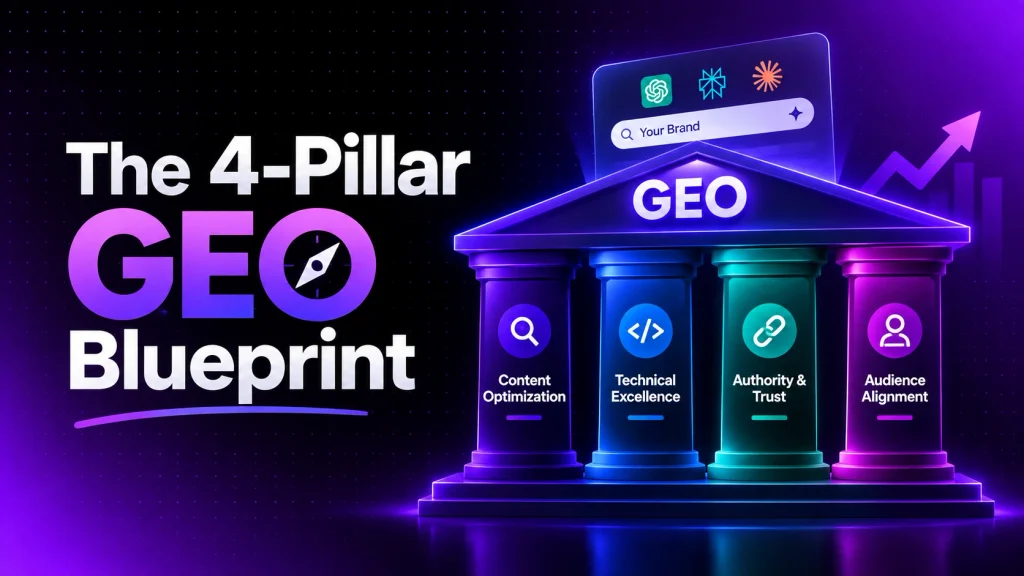
Pillar 1: Entity Graph and Structured Data
An AI system has to resolve who or what a page is actually about before it can trust anything the page says. Ambiguous entity signals (an inconsistent business name, no schema, no external corroboration) get a page passed over even when the content itself is accurate.
Fix this with:
- Organization schema (JSON-LD) on every page, not just the homepage, with a complete
sameAsarray pointing to your Wikidata entry, Wikipedia page if one exists, Crunchbase, and LinkedIn. - Person schema for named authors, tied to a real bio and real credentials, not a generic “staff writer” byline.
- Product or Service schema wherever you have a concrete offering to describe.
- The exact same brand name, founding details, and description everywhere you appear. A different founding year on your About page than on your Wikidata entry is a small inconsistency with an outsized effect on confidence scoring.
Pillar 2: Direct-Answer Architecture
Structure each section so the answer doesn’t require interpretation. Phrase the H2 as the literal question someone would type or ask out loud, follow it immediately with a two-to-three sentence answer that stands on its own, bold the key term or figure, and only then add nuance, caveats, or supporting data underneath.
- Lead every major section with an extractable, self-contained answer before the elaboration, not after it.
- Use comparison tables and matrices for anything that’s naturally a comparison, rather than describing the comparison in prose.
- Write high-density sentences. Each one should carry a distinct, checkable fact rather than restating the sentence before it in different words.
- Build bulleted implementation checklists for anything procedural, so the structure itself signals “this is a direct answer.”
Pillar 3: Third-Party Consensus and Digital Footprint
A mention on your own blog is one source describing your brand. A mention on Reddit, a G2 review, a Trustpilot rating, and an industry “best of” roundup are four independent sources agreeing with each other, and that agreement is exactly the kind of corroboration that pushes confidence scoring in your favor.
This is why AI systems lean on Reddit, Quora, G2, Trustpilot, and niche roundups more than they lean on brand-published marketing copy: independent sources are harder to fabricate at scale, and five mentions across five unrelated properties function as five separate data points, where five mentions on one domain are a single source repeating itself.
- Answer questions authentically in the communities where your buyers already ask them, rather than posting only on owned properties.
- Get listed and reviewed on the platforms relevant to your category (G2, Trustpilot, Capterra, or the industry-specific equivalent).
- Pitch inclusion in existing “best of” and comparison roundups published by third parties, rather than only publishing your own.
- Keep publishing original owned content too. It’s what earns citations from other sites in the first place, but it doesn’t substitute for independent corroboration.
Pillar 4: Technical Cleanliness and LLM Crawlability
None of the first three pillars matter if the crawler behind the citation can’t reach the page. Every major AI company now runs separate bots for training versus search, and the distinction is easy to get wrong:
| Company | Training Crawler | Search / Citation Crawler | Live Per-Query Fetcher |
|---|---|---|---|
| OpenAI | GPTBot | OAI-SearchBot | ChatGPT-User |
| Anthropic | ClaudeBot | Claude-SearchBot | Claude-User |
| Perplexity | Not applicable, neither bot trains models | PerplexityBot | Perplexity-User |
The token that governs whether you get cited is the middle column, not the first one. Blocking GPTBot or ClaudeBot opts your content out of training; it does nothing to your visibility in ChatGPT’s or Claude’s search citations.
A blanket Disallow: / written to keep training bots out, without a separate rule for the search-specific token, can quietly remove you from citations you never meant to give up. Treat each token as its own decision in robots.txt.
Beyond the robots.txt layer:
- Serve content server-side, or pre-render it. These crawlers generally don’t execute JavaScript the way a browser does, and content that only appears after client-side rendering is often an empty shell to them.
- Never gate the content you want cited behind a login wall, a paywall, or a cookie-consent screen that blocks rendering until it’s dismissed.
- Consider adding an llms.txt file at your root domain: a proposed standard, created by Jeremy Howard in 2024, that gives AI systems a curated map of your most important pages in plain markdown. No major AI provider has officially committed to reading it as of 2026, so treat it as cheap, optional insurance, not the centerpiece of your GEO plan.
Platform-Specific Tactics
Winning on Perplexity
Perplexity is the most citation-transparent of the three: nearly every answer carries visible, numbered citations, which makes it the easiest platform to test against directly. Its ranking leans hard on citability: content with original data, named studies, and verifiable claims consistently outperforms generic listicles, because the system is effectively asking whether a passage is worth citing the way a research paper would cite it.
Recency carries more weight here than on ChatGPT or Claude, so refresh anything covering a fast-moving topic on a real schedule, not just once a year. Perplexity also predicts several follow-up questions after every answer, so a page that also answers the natural next question earns a second citation in the same session. Cover a full topic cluster in one place instead of spreading it across five narrow posts.
Winning on ChatGPT Search
Because ChatGPT Search leans so heavily on Bing, being properly indexed there is a prerequisite, not a footnote, the same way Google indexing used to be the baseline assumption for everything else. Verify your site in Bing Webmaster Tools, import your settings from Google Search Console, and enable IndexNow so new and updated pages reach Bing’s index quickly.
Beyond indexing, ChatGPT tends to surface brands that show up by name across many independent conversational contexts (reviews, comparison threads, forum answers), rather than brands that simply hold the most backlinks. ChatGPT users also ask a disproportionate number of bottom-of-funnel comparison queries, “X vs Y,” “best X for Y use case,” which makes answer-ready comparison tables and honest pros-and-cons breakdowns some of the highest-leverage content you can build for this platform specifically.
Winning on Claude
Claude’s web search runs as an on-demand tool call rather than a standing index a person scrolls through, so what gets pulled into an answer depends on which pages Claude decides are worth opening in full for that specific query.
In practice, that favors original, official, and thoroughly documented sources over SEO-optimized content farms, and it favors one long, well-structured, authoritative page over the same information thinly spread across five short ones.
Claude also sees heavy use for direct document analysis, PDFs, reports, and whitepapers uploaded straight into a conversation, so publishing your deepest content as a downloadable report alongside the web page gives it a second way to enter a conversation that a web-only page doesn’t have.
The Do-Not-Do List
Any of these can quietly remove you from citations you’d otherwise earn:
- Hiding the content you want cited behind a paywall, a login wall, or a cookie gate that blocks rendering until dismissed.
- Serving your main content only after client-side JavaScript runs, invisible to a crawler that doesn’t execute scripts.
- Publishing contradictory facts about your own brand across different pages or platforms, a different founding date on your About page than on Wikipedia, for instance. It confuses entity resolution and drags down confidence scoring even when each individual page is internally accurate.
- Filling pages with generic, AI-generated content that restates what every competitor’s page already says. Zero information gain means zero reason to cite you over the next ten pages that say the same thing.
- Writing a blanket crawler block aimed at training bots that accidentally also catches OAI-SearchBot, Claude-SearchBot, or PerplexityBot.
- Keyword stuffing without ever giving a literal, direct answer to a specific question. It can hurt extraction even on pages that still rank fine in classic search.
- Skipping structured data entirely and leaving the system to guess at your entity identity from prose alone.
Tracking and Measuring Generative Visibility
Google Search Console now has a dedicated Generative AI report, still labeled Beta, under Performance. Google switched it on for a limited set of properties in June 2026 and expanded it to every property worldwide by August.
It currently reports impressions only, how often your pages appeared inside AI Overviews, AI Mode, and generative features in Discover, broken down by page, country, device, and date. There’s no click, CTR, average-position, or query-level data yet. Treat the number as a visibility signal, not a traffic signal: an impression means you were shown as a source, not that anyone clicked through.
Two more signals worth tracking alongside it:
- Referral traffic. Filter GA4 for referrer domains like chatgpt.com, perplexity.ai, and claude.ai. They show up as a distinct source once you know to isolate them, and they tend to convert differently than classic organic traffic: later-stage, higher-intent visitors who already read a synthesized answer before they ever landed on your site.
- Branded search volume. A citation doesn’t always produce an immediate click. It often produces a delayed, direct search once the reader decides to look you up. A lift in searches for your brand name plus “review” or “pricing,” without a matching lift in referral clicks, is itself evidence that GEO is working upstream of the numbers GSC shows you directly.
A growing set of dedicated AI-visibility platforms now run standing prompt panels against ChatGPT, Perplexity, Claude, and Gemini to track citation share at the query level. That’s useful once you want detail GSC’s beta report doesn’t expose yet, but GSC, GA4 referral filtering, and branded search tracking cover the fundamentals without adding another subscription.
Turning This Into a Standing Advantage
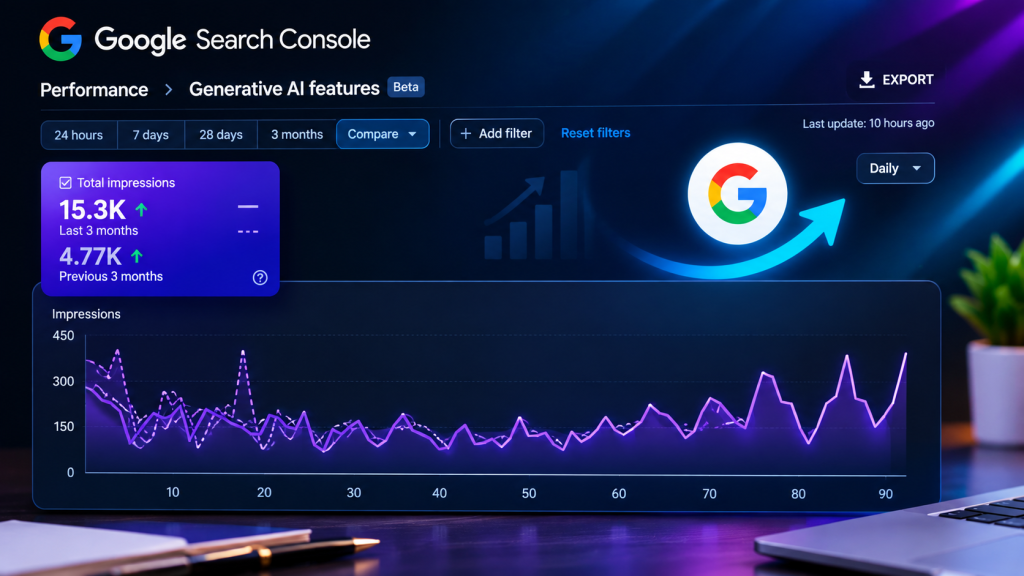
In one recent GEO engagement, generative AI impressions in Google Search Console went from roughly 4,800 to more than 15,000 across a single quarter, more than tripling, after the four pillars above were implemented in that order: technical crawl access first, then entity data, then answer-first content structure, then third-party consensus.
That sequence matters. Fixing crawlability before fixing content means the content that’s already good gets picked up faster. Fixing entity data before chasing third-party mentions means those mentions actually resolve back to your brand instead of getting lost as an unlinked, ambiguous string of text.
Antor SEO runs a Technical and GEO Audit for founders and marketing leads who want a clear picture of where their brand actually stands across ChatGPT, Perplexity, Claude, and Google’s AI surfaces today, along with a Growth Retainer for teams who want the four-pillar work executed on an ongoing basis.
The audit covers your entity data, your crawl access for OAI-Search Bot, Claude-Search Bot, and Perplexity Bot specifically, your current citation footprint, and a prioritized list of what to fix first. Book a consultation at Nayem Khan to see where your brand actually stands in AI search right now.