
5 years ago, keyword research meant typing a phrase into a tool, sorting by search volume, and picking whatever had the biggest number next to it. That approach barely works anymore. Google now answers a huge share of queries directly inside the search results through AI Overviews, and a growing number of searches happen through conversational, multi-turn interfaces rather than a single typed phrase.
At its core, keyword research is still the same simple idea: figuring out what your audience actually types, asks, or says when they’re looking for something you can help with. What’s changed is the layer underneath that idea. Search engines no longer just match strings of text; they interpret meaning, connect concepts to real-world entities, and try to resolve the question behind the question.
That’s why keyword research still matters, arguably more than ever. AI-driven search results still have to be trained on something, and that something is content that demonstrates real expertise around a topic. Ranking in an AI Overview, a featured snippet, or a traditional blue link all start from the same place: understanding the language, intent, and structure real people use when they search.
Part of that shift is conversational. People increasingly search the way they’d ask a knowledgeable friend, in full sentences, sometimes by voice, sometimes across several follow-up questions in the same session. A single keyword phrase can no longer capture the full range of ways someone might arrive at the same underlying question. Planning around topics and entities, rather than isolated phrases, is what actually keeps a content strategy relevant as search behavior keeps changing.
This guide walks through how to do keyword research the way it actually works in 2026, from brainstorming seed topics through building topic clusters, choosing the right tools, and avoiding the mistakes that quietly tank a content plan.
Understanding Modern Search Intent
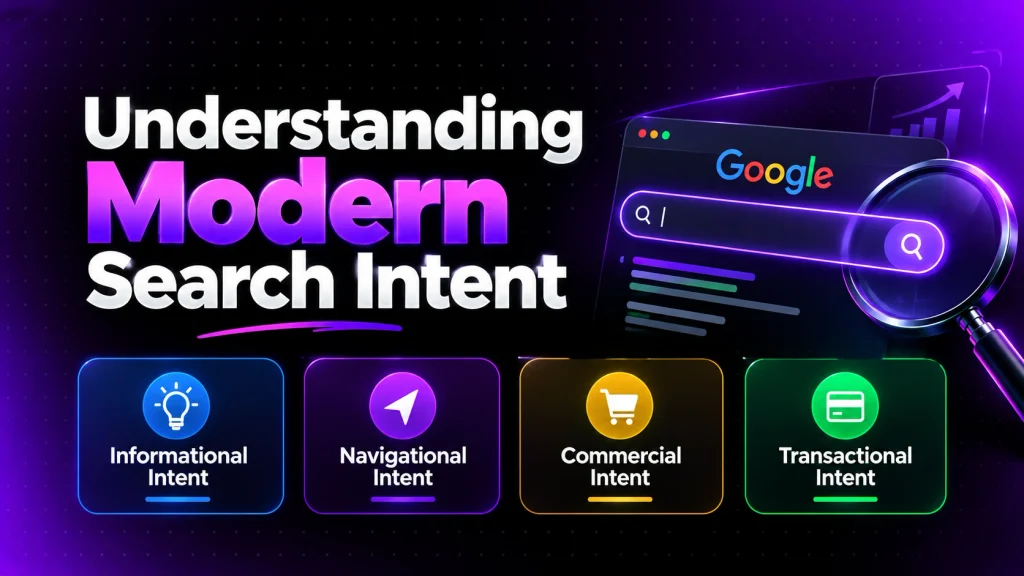
Every keyword carries an intent, and mismatching content to intent is one of the fastest ways to waste months of writing. The classic framework still holds, but each category has evolved.
Informational Intent
The searcher wants to learn something. “How does keyword research work” or “what is search intent” are classic examples. These queries are now the most likely to trigger an AI Overview, since the goal is usually a direct answer rather than a product.
Navigational Intent
The searcher already knows where they want to go, like “Ahrefs login” or “Semrush pricing page.” There’s little room to compete here unless you’re the brand itself.
Commercial Investigation Intent
The searcher is comparing options before buying. “Best keyword research tools for beginners” or “Ahrefs vs Semrush” fall here. This is often the most valuable intent to target, because the reader is close to a decision.
Transactional Intent
The searcher is ready to act: “buy Semrush subscription,” “keyword research tool free trial.” Conversion-focused pages belong here.
The Emerging Zero-Click and AI Overview Intent
A growing slice of queries are answered fully inside the search results page, especially short factual questions. Ranking a page for these terms doesn’t guarantee a click, but appearing as the cited source inside an AI Overview still builds visibility and trust, and it often pulls in the more complex follow-up questions that AI Overviews can’t fully answer.
Note: A keyword’s intent can shift over time as Google’s SERP features change. It’s worth re-checking intent for your priority keywords every few months, not just once at the start of a project.
The Best Keyword Research Tools for 2026 (Free & Paid)
Step 1: Brainstorm Seed Topics and Build Topic Clusters
Start broad. List the core subjects your business genuinely has expertise in, not individual keywords yet. A site about project management software might start with seed topics like “task management,” “team collaboration,” and “project timelines.”
From each seed topic, branch outward into subtopics. This becomes the foundation of a topic cluster: one comprehensive pillar page supported by several narrower, interlinked articles. Search engines increasingly reward this structure because it signals topical depth rather than a single isolated page trying to rank for everything.
Step 2: Map Entities and Knowledge Graph Connections
Modern search engines think in entities: people, places, concepts, and things with defined relationships to each other, not just isolated strings of text. When researching a topic, look at who and what Google already associates with it.
A practical way to do this is checking the “People also ask” boxes, related searches, and the entities Google’s own Knowledge Graph surfaces for your seed topic. If you’re writing about “keyword research tools,” Google already understands the entities Ahrefs, Semrush, and Google Search Console as connected to that topic. Referencing and correctly contextualizing those entities helps a search engine place your content in the right semantic neighborhood.
This matters more in 2026 because ranking well no longer depends on repeating an exact keyword phrase over and over. Search systems now compare the full set of concepts a page covers against the full set of concepts a searcher’s query implies. A page about “keyword research” that never mentions search intent, SERP features, or topic clusters looks thin to a search engine, even if the exact phrase “keyword research” appears twenty times. Covering a topic’s related entities thoroughly, in natural language, does more for rankings than keyword density ever did.
Step 3: Find Low-Competition, High-ROI Long-Tail Queries
Long-tail keywords, the longer and more specific phrases, are still the easiest place for smaller or newer sites to gain traction. “Keyword research” is nearly impossible to rank for without years of authority. “Free keyword research tool for local businesses” is far more achievable and often has clearer commercial intent.
Look for queries with:
- A clear, narrow intent that your page can fully satisfy
- Moderate search volume rather than zero
- Weak or outdated competing content in the current results
Step 4: Reverse-Engineer SERP Features and Run a Competitor Gap Analysis
Search the keyword yourself and study what’s already ranking. Ask a few questions:
- Are there featured snippets, video carousels, or AI Overviews present?
- What subtopics do the top three results all cover?
- What do they leave out that a searcher would still want to know?
A gap analysis, comparing your existing content against top competitors, often reveals subtopics, questions, or formats (like comparison tables or FAQs) that nobody has covered well yet. That gap is where new content earns its ranking.
Step 5: Prioritize by Business Potential, Not Just Search Volume
A keyword with 50 monthly searches and strong buying intent can be worth more than one with 5,000 searches and no commercial relevance. Score each keyword candidate on:
- How closely it matches what your business actually sells or does
- Where the searcher likely sits in their decision journey
- Realistic ranking difficulty given your site’s current authority
This is also where many teams benefit from an outside perspective. A professional SEO audit can help separate keywords that look impressive on paper from the ones that will actually move revenue.
Business Value vs. Vanity Search Volume
It’s tempting to chase the keyword with the biggest number in a research tool. But search volume by itself doesn’t tell you whether ranking for that term will bring in a single customer.
A more useful way to score a keyword is to ask three questions before committing time to it:
- Would someone searching this term realistically consider buying what we sell?
- Does ranking for it position us in front of the right stage of the buyer’s journey?
- If we ranked number one tomorrow, would that traffic show up anywhere in our business metrics, not just our analytics dashboard?
Two keywords with the same volume can have wildly different value. “What is keyword research” gets far more searches than “keyword research consultant for healthcare startups,” but the second is closer to a paying customer. Building a keyword plan that mixes a handful of high-volume educational terms with a larger set of narrow, commercially relevant ones tends to outperform a plan built on volume alone.
The Ultimate Keyword Research Toolkit for 2026
Free Keyword Research Tools
- Google Search Console – Shows the exact queries already driving impressions and clicks to your site, which is often more reliable than third-party volume estimates.
- Google Keyword Planner – Useful for rough volume ranges and seasonal trends, especially when paired with paid search data.
- AnswerThePublic – Visualizes question-based and preposition-based queries around a seed term, useful for FAQ and content-angle ideas.
- Keyword Surfer (browser extension) – Shows estimated volume directly in the search results as you browse.
Premium Keyword Research Tools
- Ahrefs – Strong for competitor gap analysis, backlink-adjusted difficulty scoring, and content explorer features. Ahrefs publishes a detailed step-by-step keyword research walkthrough worth reading alongside this guide.
- Semrush – Broad all-in-one platform covering keyword research, position tracking, and technical audits, with its own practical keyword research walkthrough covering the Keyword Magic Tool and Keyword Gap features.
- SE Ranking – A more budget-friendly alternative with solid keyword grouping and rank tracking.
AI-Assisted Keyword and Entity Discovery
Large language models like Claude and ChatGPT are useful for a different part of the process: expanding a seed topic into related entities, generating natural-language question variants, and drafting topic cluster outlines. They’re not a replacement for actual search volume data, but they’re strong at surfacing the conversational phrasing real users now type or speak.
Comparison Table
| Tool | Free/Paid | Best Feature | 2026 Rating |
|---|---|---|---|
| Google Search Console | Free | Real click and impression data from your own site | 5/5 |
| Google Keyword Planner | Free | Broad volume ranges and seasonal trends | 3.5/5 |
| AnswerThePublic | Free (limited) | Question and long-tail query visualization | 4/5 |
| Ahrefs | Paid | Competitor gap analysis | 4.5/5 |
| Semrush | Paid | All-in-one keyword and technical SEO suite | 4.5/5 |
| SE Ranking | Paid | Budget-friendly keyword grouping | 4/5 |
For the latest official guidance straight from the source, Google Search Central’s SEO documentation is worth bookmarking and checking periodically, since ranking factors and SERP features continue to evolve.
Real-Life Example: Turning One Broad Keyword Into a Five-Pillar Cluster
Take the broad seed keyword “email marketing.” On its own, it’s far too competitive and too vague to target directly. Here’s how it could break down into a workable cluster:
- Pillar page: “Email Marketing: The Complete Guide” (broad, comprehensive overview)
- Cluster post 1: “How to Build an Email List From Scratch”
- Cluster post 2: “Best Email Marketing Software for Small Businesses”
- Cluster post 3: “Email Subject Lines That Actually Get Opened”
- Cluster post 4: “Email Marketing Automation Workflows Explained”
Each cluster post links back to the pillar page, and the pillar page links out to each cluster post. This structure signals topical authority to search engines and gives readers a natural path to explore related questions, which tends to improve both rankings and on-site engagement over time.
Notice that none of the five titles above repeat “email marketing” mechanically. Each one targets a distinct sub-intent, list building, software comparison, subject lines, and automation, while still clearly belonging to the same topic. That’s the difference between a cluster built around genuine subtopics and a set of pages that all fight over the same phrase.
Common Keyword Research Mistakes to Avoid in 2026
Targeting high-volume keywords with zero commercial value. Ranking for a term nobody who could become a customer is actually searching for doesn’t move the business forward, even if the traffic graph looks good.
Ignoring how SERP intent has shifted. A keyword that used to return blog posts might now return a shopping carousel or an AI Overview. Content built for the old SERP won’t perform on the new one.
Keyword cannibalization and over-optimization. Publishing multiple pages that all target the same core keyword forces them to compete with each other instead of the actual competition, and it confuses search engines about which page should rank.
Chasing volume instead of specificity. A narrower, well-answered query often converts and ranks better than a broad one stuffed with generic advice.
Skipping the “why” behind a query. Two keywords can look nearly identical in a tool and still have completely different intent behind them. Reading the actual top-ranking results is still the fastest way to catch this.
Treating keyword research as a one-time project. Search behavior, SERP layouts, and competitor content all shift over time. A keyword list built once and never revisited slowly drifts out of sync with how people are actually searching, especially as AI Overviews continue to reshape which queries still send clicks to a website at all.
Conclusion and Actionable Checklist
Keyword research in 2026 isn’t about chasing volume numbers in isolation anymore. It’s about understanding intent, mapping topics to entities, and building content clusters that demonstrate real depth on a subject, whether the reader lands on your page directly or meets your content inside an AI-generated answer.
Quick 5-step checklist to get started:
- List 5 to 10 seed topics your business genuinely has expertise in
- Expand each seed into long-tail, specific queries using free tools like Google Search Console and AnswerThePublic
- Check the current SERP for each priority keyword to confirm the intent still matches your planned content
- Group related keywords into a pillar-and-cluster structure
- Prioritize by business relevance and realistic ranking difficulty, not raw search volume
Frequently Asked Questions
-
What is keyword research in simple terms?
Keyword research is the process of finding the exact words and phrases your target audience uses when searching, so you can create content that matches what they’re actually looking for.
-
How do I do keyword research for free?
Start with Google Search Console to see what’s already driving traffic to your site, then expand using free tools like Google Keyword Planner and AnswerThePublic to find related long-tail queries.
-
What is the best free keyword research tool?
Google Search Console is generally the most valuable free tool, since it shows real search queries and click data from your own website rather than estimated figures.
-
Is keyword research still important with AI Overviews and zero-click search?
Yes. AI Overviews are generated from content that already demonstrates clear expertise on a topic, so understanding search intent and language is still the starting point for getting cited or ranked.
-
How many keywords should a single page target?
A page should have one primary keyword and a small cluster of closely related terms it can naturally cover in depth. Trying to target multiple unrelated primary keywords on one page usually weakens its focus and ranking potential.