
Key Takeaways
- A B2B SEO strategy targets buying committees and long sales cycles, so build it around buyer questions at every stage.
- Fix technical issues on your money pages before you publish more content.
- Topic clusters, original insight, and expert review build trust with buyers and search engines.
- Good SEO already supports AI search visibility (GEO and AEO), so treat them as one system.
- Measure qualified leads and pipeline, not just rankings and traffic.
A B2B SEO strategy is a plan to attract business buyers through search by matching your content to each stage of a long sales cycle. You build it by defining your buyers, researching their questions, fixing technical issues, publishing useful content, earning trust signals, and tracking pipeline instead of traffic.
This playbook walks through each step in order. It also covers b2b seo best practices for AI search, where buyers often get answers before they click. Follow the steps, and you will have a clear, repeatable system your team can run all year.
What Is a B2B SEO Strategy?
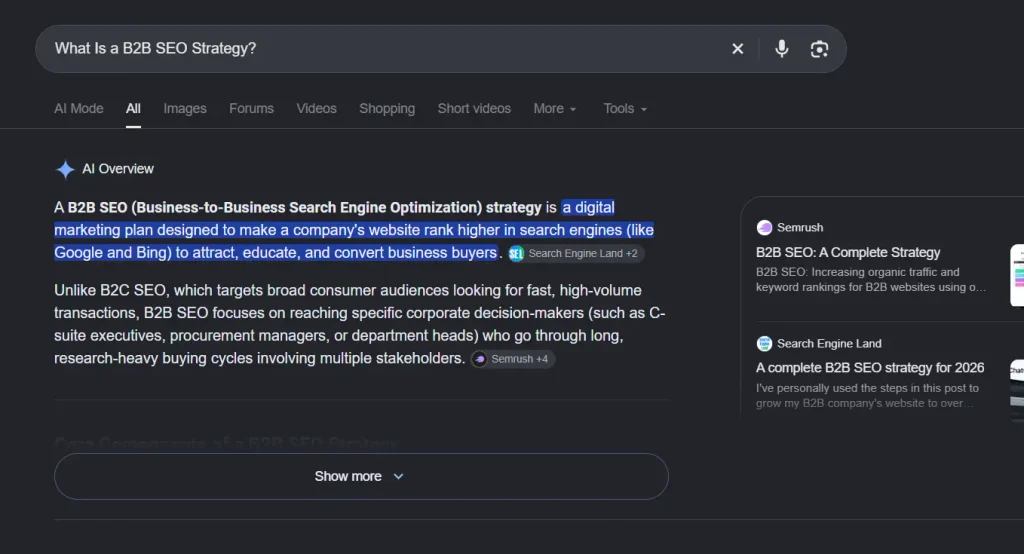
A B2B SEO strategy is a structured plan to earn search visibility with business buyers. It targets decision makers and committees, not single shoppers. Content supports a long sales cycle, from early research to vendor comparison. Success is measured by qualified leads and pipeline, not raw traffic. If you are new to the basics, start with my guide on what is SEO.
How B2B SEO Differs from B2C SEO
B2B search volumes are usually smaller. The buyers are fewer, the deals are bigger, and several people weigh in on one purchase.
That changes the work. You write for a CFO, an operations lead, and an end user, often on the same deal. One qualified lead from a low-volume keyword can be worth more than thousands of casual visits.
If you sell software, my SaaS SEO services follow this same process.
Step 1: Define Your Buyers and Goals
Start by naming your ideal customer profile, the roles that influence a purchase, and one business goal such as demo requests. Interview sales and customer teams to learn real objections. Write down the questions buyers ask at each stage. This gives every later SEO decision a clear target.
Questions to Ask Your Sales Team
- What do buyers ask on the first call?
- Which objections slow deals down?
- Which competitors come up most often?
- What do won customers say convinced them?
Their answers become your content roadmap. They also give you language that matches how buyers actually talk.
Step 2: Research Keywords by Buying Stage
Group keywords by buying stage. Awareness terms are problems and questions. Consideration terms compare solutions and approaches. Decision terms include alternatives, pricing, and vendor names. Pick a few terms per stage, check search intent on the live results, and give every keyword one page so your content does not compete with itself.
Here is an example for a company selling payroll software:
- Awareness: “how to automate payroll”
- Consideration: “payroll software vs outsourcing”
- Decision: “[brand] alternatives”
I explain the full process in my keyword research guide. Use Google Search Console to see which queries already bring impressions, then build on those.
Step 3: Fix Your Technical Foundation
Make sure search engines can crawl, render, and index your key pages. Check indexing in Google Search Console, fix broken links and redirect chains, keep pages fast on mobile, and use a clean URL structure. Add schema markup where it fits. Technical issues on money pages quietly block growth, so audit them first.
A Quick Technical Checklist
- Product, service, and pricing pages are indexed.
- No important page is blocked by robots.txt or a stray noindex tag.
- Core Web Vitals pass on mobile.
- The XML sitemap lists only live, canonical URLs.
- Organization and Article schema markup validates without errors.
Google’s own SEO Starter Guide covers the basics well. For a full list of checks, use my technical SEO checklist.
Step 4: Build Topic Clusters and Content That Earns Trust
Build topic clusters: one pillar page on a core topic, supported by detailed articles that answer specific questions and link back to it. Add product pages, comparison pages, and case studies for buyers close to a decision. Write with first-hand experience, name real examples, and have a subject expert review every piece.
Content Types That Work for B2B
- Pillar pages on your core topic
- How-to articles for specific problems
- Comparison and alternatives pages
- Case studies with real results
- Original data, templates, and calculators
Google says it rewards helpful, people-first content. Its guidance on creating helpful content is worth reading before you plan a calendar. Your SEO content strategy should tie each article to a buyer question and a next step.
Link each cluster article to its pillar and to its siblings. My internal linking guide shows how to do it without overdoing it.
Show real experience too. Buyers and search engines both look for E-E-A-T signals such as author bios, named sources, and proof of results.
Step 5: Optimize for AI Search (GEO and AEO)
To show up in AI answers, write clear, direct answers under question-style headings, keep facts accurate and sourced, and use consistent brand and author details across the web. Add structured data, keep pages crawlable, and earn mentions on trusted sites. GEO and AEO build on good SEO rather than replace it.
Practical GEO and AEO Moves
- Put a 40 to 60-word answer right under each question heading.
- Cite sources for facts and figures.
- Keep author bios, company details, and product names consistent everywhere.
- Update older pages so numbers and screenshots stay current.
- Check that AI crawlers you want are not blocked in robots.txt.
Google explains how its AI features pick sources in its documentation on AI features and your website.
For the full picture, read my guides on generative engine optimization and what is AEO.
Step 6: Build Authority and Links
Earn links by publishing things worth citing, such as original data, templates, and expert commentary. Pursue relevant links from industry sites, partners, and customers rather than volume. Support this with digital PR, podcast guest spots, and strong profiles on review platforms. A few relevant links beat many weak ones.
Start close to home. Ask partners, integrations, and happy customers to link to you. Then move to guest articles and industry roundups.
Avoid paid link schemes and low-quality directories. They put your rankings at risk. A steady, honest approach to link building strategies is slower but safer.
Step 7: Measure Pipeline, Not Just Traffic
Track what the business cares about: qualified leads, demo requests, pipeline, and revenue from organic search. Connect Google Analytics 4 to your CRM, and use Search Console for query data, so you can see which pages assist deals. Review results monthly, update what slips, and double down on pages that bring qualified buyers.
Metrics to Report Each Month
- Organic leads and demo requests
- Pipeline and revenue from organic sessions
- Rankings for your priority keywords
- Indexed pages and Core Web Vitals status
- Mentions and links earned
Keep reports short. A one-page summary that ties SEO to sales gets read.
B2B SEO Best Practices to Follow in 2026
The best B2B SEO practices are simple: target buyer questions, match search intent, keep pages fast and crawlable, publish expert-led content, and measure revenue impact. Refresh older pages often. Cover each topic in depth rather than chasing many thin keywords.
Many teams also underuse proof. Add named customers and real numbers to key pages. This SaaS SEO case study shows how results can be presented. Buyers trust evidence more than claims.
These b2b seo strategies work best when they run together. Content without technical health stalls. Technical health without content has nothing to rank.
A Simple 90-Day B2B SEO Plan
Spend month one on research and technical fixes, month two on publishing your pillar page and first cluster articles, and month three on links, AI search updates, and reporting. Review results at day 90, then repeat the cycle with the next topic.
Month 1: Define buyers, research keywords, run a technical audit, and fix blockers.
Month 2: Publish one pillar page and three to four cluster articles. Add internal links between them.
Month 3: Start outreach, add FAQ and schema to key pages, set up lead tracking, and build your first report.
FAQ: B2B SEO Strategy
-
What is the best B2B SEO strategy?
The best approach starts with your buyers, not keywords. Map their questions to each stage of the sales cycle, fix technical issues, and publish expert content that answers those questions. Then measure leads and pipeline.
-
How long does B2B SEO take to work?
Many teams see early ranking movement in 3 to 6 months, but timing depends on competition, site authority, and publishing pace. Revenue usually lags further behind because B2B sales cycles are long.
-
How is B2B SEO different from B2C SEO?
B2B targets smaller audiences and multi-person buying committees. Content is deeper, sales cycles are longer, and one qualified lead can be worth far more. B2C often focuses on higher volume and faster purchases.
-
Does B2B SEO still matter with AI search?
Yes. AI answers pull from pages that are clear, accurate, and trusted, which is what good SEO produces. Adding direct answers, structured data, and consistent brand details helps your pages get cited. See how to optimize for Google AI Overviews for the steps.
-
Which KPIs should I track for B2B SEO?
Track qualified leads, demo requests, pipeline, and revenue from organic search. Rankings and traffic are useful supporting numbers, but they do not prove business impact on their own.
Conclusion
A strong B2B SEO strategy follows a clear order. Define your buyers, research keywords by stage, fix technical issues, and build topic clusters with expert content. Then optimize for AI search, earn relevant links, and measure pipeline.
Start small and stay consistent. One solid pillar page and a few useful cluster articles will teach you more than a big plan that never ships.
Written by Nayem Khan, SEO and GEO consultant at Antor SEO.