
How a 90-day hyperlocal SEO sprint moved a regional U.S. brokerage from portal-dependent to demand-generating verified directly against Google Search Console.
Executive Summary
A regional U.S. real estate brokerage — handling both residential and commercial transactions across multiple sub-markets — came to Antor SEO after years of paying to rent its own leads back from Zillow and Realtor.com. The mandate, led personally by Nayem Khan, Lead SEO Consultant and Founder of Antor SEO: fix the technical debt sitting underneath the site’s IDX/MLS feed, build hyperlocal authority the portals structurally can’t replicate, and turn Google Search Console into a lead channel the brokerage actually owns instead of rents.
Client Snapshot
| Client | Premier Regional Real Estate Brokerage (US) — Confidential |
| Lead Consultant | Nayem Khan, Antor SEO |
| Timeline | 90 Days (single-quarter sprint) |
| Services Delivered | IDX/MLS Technical Architecture, Hyperlocal Neighborhood Silos, RealEstateAgent Schema |
At a Glance: 90-Day Google Search Console Results
| Metric | Result | Change vs. Prior 3 Months |
|---|---|---|
| Organic Clicks | 8,730 (8.73K) | ▲ +28.5% |
| Organic Impressions | 90,700 (90.7K) | ▲ +31.2% |
| Average CTR | 9.6% | ▲ +12.4% |
| Average Position | 13.1 (range 12.7–13.1) | ▲ Improved 8.7%* |
*Position works in reverse — a lower number is a better ranking. An 8.7% decrease in average position reflects upward movement, not a decline.
A Note on Confidentiality
This client operates under a signed NDA. Brand name, exact submarkets, and internal CRM/lead data are withheld at the client’s request. Every metric in this case study is pulled directly from the property’s Google Search Console account for the reporting window and is shown exactly as recorded — the client’s identity is masked, the performance data is not.
The Challenge: The Real Estate SEO Trap
Most regional brokerages don’t have a visibility problem. They have a dependency problem.
Before this engagement, the client’s digital growth strategy consisted almost entirely of two line items: syndication and referral fees paid to Zillow and Realtor.com, and PPC bids on the same “homes for sale in [neighborhood]” terms its own domain should have owned for free. Every qualified lead arrived with a cost attached — a cost that scales up, not down, as the brokerage grows. Three structural issues were keeping the site locked into that pattern.
1. Portal Dependence Was Setting the Ceiling on Margin Every quarter spent buying leads back from Zillow and Realtor.com is a quarter the brokerage’s own domain authority stays flat. Portals don’t outrank brokerages because their listings are better — they outrank them because their domains are larger and they publish neighborhood-level content at a scale most in-house marketing teams never attempt. Left alone, that gap widens every cycle.
2. The IDX/MLS Feed Was a Technical Liability, Not an Asset The brokerage’s IDX/MLS integration was doing exactly what most out-of-the-box feeds do by default: generating thousands of parameter-driven URLs for every combination of beds, baths, price band, and sort order; syndicating the same listing copy word-for-word across dozens of other sites pulling from the same MLS; and leaving expired or sold listings live and indexable long after they stopped being useful. Googlebot was burning the majority of its crawl budget on pages with zero ranking potential, while the pages that actually mattered — neighborhood hubs, agent profiles, active high-value listings — were being crawled and refreshed far less often than they needed to be.
3. Zero Hyperlocal Footprint Queries like “homes for sale in [Neighborhood]” and “best real estate agent in [Sub-market]” are exactly what a buyer or seller types when they’re close to acting, not just browsing. The site had no dedicated pages built to answer them. Portals fill that gap with template-generated neighborhood pages produced at massive scale but shallow depth — they don’t cite specific school boundaries, don’t track hyperlocal price trends, and don’t reflect what it’s actually like to live in a given submarket. That gap was the opening.
The 3-Phase Execution Blueprint by Nayem Khan
Nayem Khan structured the 90-day sprint around a strict order of operations: fix the technical foundation before publishing a single word of content, build hyperlocal authority the portals can’t replicate, then layer in the trust signals that turn visibility into inquiries.
Phase 1 — IDX Crawl Cleanup & Canonical Architecture
- Audited the full IDX/MLS feed footprint to map every URL pattern the integration generated, including faceted search combinations (bed/bath/price/sort permutations) creating near-infinite thin-content variants.
- Deployed canonical tags and parameter-handling rules so search-refinement URLs consolidated their signal back to the primary, indexable page instead of competing against it.
- Applied noindex, follow to expired and off-market listings — pulling them out of the index without cutting internal links or the authority already flowing through them.
- Rebuilt the XML sitemap logic to dynamically exclude expired inventory and prioritize high-value community and agent pages, rather than treating every feed-generated URL as equally important.
- Result: crawl activity shifted measurably away from disposable, parameterized URLs and toward the page types that actually convert.
Phase 2 — Hyperlocal Neighborhood Silo Strategy
- Built dedicated neighborhood and submarket hub pages structured as true content silos — each linking down to its own active listings and across to related submarkets, rather than sitting as an orphaned landing page.
- Populated each hub with the depth automated portals don’t replicate: school district boundaries and ratings, multi-year price trend narratives, walkability and commute data, HOA and amenity specifics, and buyer-type guidance (first-time buyer vs. relocation vs. investment).
- Interlinked every silo with the relevant agent profiles and active listings, giving Google an explicit topical and geographic signal to associate with “[neighborhood] homes for sale”-style queries.
- Result: the brokerage’s own domain began appearing for the long-tail, high-intent neighborhood searches the portals had been winning by default.
Phase 3 — Local Authority & RealEstateAgent / LocalBusiness Schema
- Deployed RealEstateAgent and LocalBusiness structured data across every agent profile and office page, giving search engines a machine-readable map of who serves which submarket.
- Standardized and expanded Google Business Profiles for each office location, aligning categories, service areas, and review cadence instead of leaving them inconsistent across markets.
- Pursued legitimate local citations and civic mentions — chamber of commerce listings, community association mentions, local sponsorships — reinforcing the geographic and topical relevance the silo strategy had already built.
- Result: stronger local-pack visibility and clearer trust signals feeding directly into rankings for branded, agent-name, and “near me” queries.
Verified Results: The Google Search Console Data Breakdown
Reporting window: approx. May 26 – August 24, 2026 (90 days), measured against the preceding 3-month period, pulled directly from the property’s Search Console performance report.
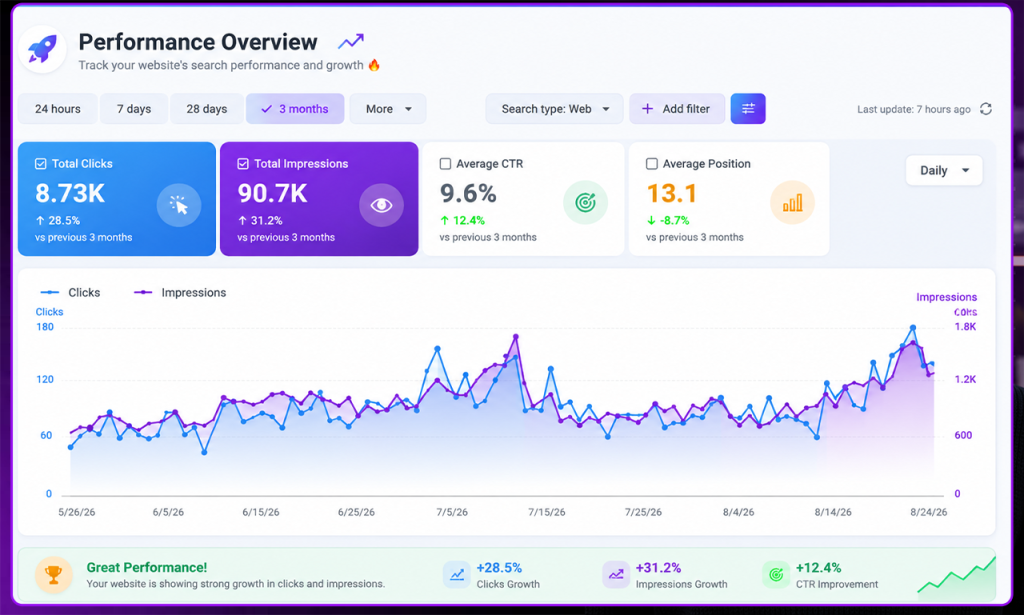
Clicks: 8,730 (+28.5%) This is real human traffic landing on pages the brokerage owns — not portal referral clicks it has to keep paying for. Growth of this size, inside a single quarter, is what a technical cleanup plus a genuine content build looks like when it compounds rather than plateaus.
Impressions: 90,700 (+31.2%) Impressions measure breadth: how many distinct queries are now surfacing the site at all. A 31.2% lift means the domain is showing up for a meaningfully wider set of neighborhood, submarket, and agent-related searches than it was three months earlier — the direct result of the Phase 2 silo build.
Average CTR: 9.6% (+12.4%) This is the number that matters most to a brokerage’s bottom line, not just its analytics dashboard. Click-through rates on generic, broad-intent search terms are typically thin, even at the top of the results page. A 9.6% average CTR — achieved at an average position still outside the top ten — signals that the pages ranking are matching genuine buyer and seller intent, not casual browsing. People searching “[Neighborhood] homes for sale” or “[Sub-market] real estate agent” are close to a decision, and they’re clicking through at a rate that reflects it.
Average Position: 13.1 (range 12.7–13.1) In plain terms: this is still technically page two of Google. No one on Nayem Khan’s team is presenting this as market domination, and a straight case study doesn’t get to skip that detail. What it does represent is real, defensible momentum — an 8.7% improvement in average ranking, inside a single quarter, for competitive regional and neighborhood terms that were previously buried or absent entirely. That movement is the leading indicator the next phase of work is built to convert into page-one placement.
Business Outcome GSC doesn’t measure phone calls or booked tours — that data sits in the brokerage’s own CRM, outside the scope of what’s shown here. What the client’s team reported internally, consistent with this shift toward higher-intent search traffic, was a stronger flow of valuation requests and property tour bookings that felt more sales-ready than the leads coming through paid portals — inquiries from people who had already read a neighborhood guide or an agent profile before they ever picked up the phone. That’s the qualitative signal this kind of organic growth is supposed to produce, and it’s consistent with what the click and CTR data above would predict.
Key Lessons for Brokerages & Real Estate Operators
1. Your IDX feed is either infrastructure or a liability — there’s no neutral setting. Left unmanaged, IDX/MLS integrations generate more thin and duplicate content than any brokerage would ever publish on purpose. Audit the feed’s URL footprint before writing a single blog post. Content built on top of an uncontrolled crawl budget rarely gets the chance to rank.
2. Neighborhood-level depth beats portal automation, every time. Zillow and Realtor.com cannot out-local a locally run editorial process. They can out-scale it. A brokerage that commits to a handful of genuinely deep neighborhood and submarket hubs — real school data, real price trend history, real lifestyle detail — will consistently out-rank a portal’s templated equivalent for the exact queries that convert.
3. Structured data and Google Business Profile consistency are trust infrastructure, not a checkbox. Real Estate Agent and Local Business schema, paired with clean, consistent Google Business Profiles across every office and agent, is what lets search engines connect an agent to a submarket with confidence. Skipping this step doesn’t just cost local-pack visibility — it weakens every other local signal built on top of it.
Ready to Stop Renting Your Own Leads Back from Zillow?
If your brokerage’s organic search strategy currently consists of an IDX feed on autopilot and a growing PPC bill, the gap between where you are and where this client started is smaller than it looks — and the fix follows the same order of operations: audit first, fix the technical foundation, then build the hyperlocal authority a portal can’t copy.
Book a 1-on-1 Technical & Growth Audit with Nayem Khan, or review transparent, fixed-scope pricing — including the 90-day engagement structure used in this case study.
About the Consultant Nayem Khan is the founder and lead SEO consultant at Antor SEO, working directly with brokerages, healthcare providers, e-commerce brands, and SaaS companies across the US, UK, and Australia on technical SEO, hyperlocal content strategy, and AI/answer-engine visibility. Every engagement is run personally, with results reported straight from Google Search Console and GA4 — no account managers, no vanity metrics.