
SEO (Search Engine Optimization) is the process of improving a website so search engines can better understand its content and users can find it through relevant organic search results. It involves optimizing content, site structure, technical performance, and relevant links to make a website more useful, accessible, and discoverable.
What Is SEO?
SEO stands for Search Engine Optimization. It is the practice of improving a website and its content so that search engines can better understand it and people can find it through relevant organic search results. Google describes SEO as helping search engines understand your content and helping users find your site through a search engine. (Google’s SEO Starter Guide)
SEO is not a trick for forcing a page to the top of Google. It is a long-term process that combines useful content, clear information architecture, technical accessibility, relevant links and a good experience for visitors. Google does not guarantee that a page will be crawled, indexed or shown in search results, even when a site follows its recommendations. (Google’s How Search Works guide)
Why is SEO important?
Search engines connect people with information, products, services and organizations at the moment they are looking for them. If your website appears for relevant searches, it can attract qualified organic traffic, increase brand visibility, generate leads and support sales without paying for every individual click.
However, visibility alone is not the real goal. A page that ranks for the wrong query may receive visitors who never become customers. Effective SEO connects three things: what people search for, what your business or website genuinely offers, and the best format for satisfying the searcher’s intent.
SEO can also improve the overall quality of a website. Clear headings, useful navigation, descriptive links, fast and accessible pages, and well-structured content help both search engines and human visitors. The results are usually cumulative rather than immediate, and they depend on competition, content quality, technical health, authority and the industry in which a site operates.
How does Google Search work?
Google Search can be understood through three main stages: crawling, indexing and serving search results. (Google Search Central documentation)
| Stage | What happens | What website owners should do |
|---|---|---|
| Crawling | Googlebot discovers URLs and downloads text, images and videos from accessible pages. | Keep important pages accessible, use crawlable links and submit an appropriate sitemap. |
| Indexing | Google analyzes the page, including its text, title, images, videos and metadata, and stores information in its index. | Publish clear, valuable content and avoid accidental noindex directives or confusing duplicates. |
| Serving results | When someone searches, Google retrieves and ranks results it considers relevant and useful for that query. | Match search intent, explain the topic clearly and provide a strong page experience. |
Google may discover pages through links, sitemaps and previously known URLs. Crawling does not guarantee indexing, and indexing does not guarantee that a page will appear for every related query. Google also states that it does not accept payment to crawl a site more frequently or rank it higher. (Google’s Search fundamentals)
What are the main types of SEO?
SEO is commonly divided into on-page SEO, technical SEO and off-page SEO. Local SEO, e-commerce SEO and international SEO are specialized applications that build on these foundations.
1. On-page SEO

On-page SEO focuses on the content and elements within an individual page. It includes understanding search intent, choosing a useful topic, creating a clear content structure, writing descriptive titles and headings, improving URLs, adding meaningful image alt text, using internal links and covering the subject comprehensively.
A page title should accurately describe the page, remain reasonably concise and help users understand why the result is relevant. Google advises against keyword stuffing, repetitive boilerplate titles and vague descriptions. (Google’s title link guidelines) A natural title such as “What Is SEO? How Search Engine Optimization Works” is more useful than a title that repeats the same keyword several times.
On-page SEO does not mean inserting a keyword into every sentence. It means using language that readers naturally use while explaining the topic completely and clearly. Related concepts, examples, definitions and practical steps often provide more value than repeated exact-match phrases.
2. Technical SEO
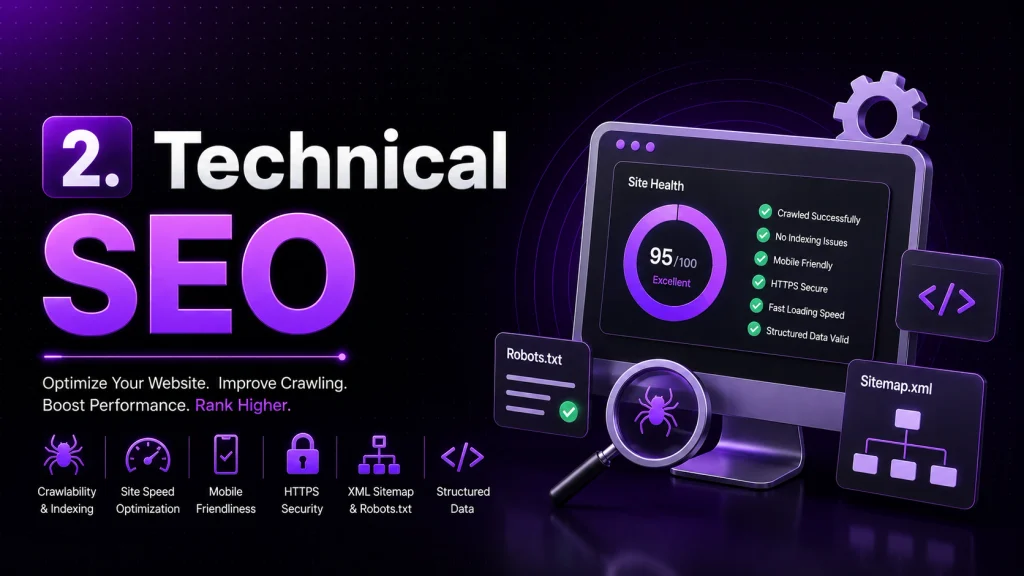
Technical SEO improves the foundation that allows search engines and users to access, interpret and use a website. Common areas include crawlability, indexability, XML sitemaps, robots.txt, canonicalization, mobile usability, HTTPS, page performance, structured data and JavaScript rendering.
The technical requirements are often simpler than beginners expect. The essential question is whether Google can access the page, understand its main content and process it without unnecessary obstacles. Technical SEO should support the content rather than become a collection of isolated scores and tool recommendations.
3. Off-page SEO

Off-page SEO covers activities outside your website that help build reputation, authority and awareness. Relevant editorial links, digital PR, expert citations, genuine brand mentions and participation in appropriate industry communities may contribute to a site’s visibility and trust.
Link building should never be reduced to buying large quantities of artificial links. Google recommends descriptive, concise and relevant anchor text. Internal links help people and Google understand the relationship between pages, while relevant external links can provide context and support source attribution. (Google’s crawlable links guide)
What is keyword research?
Keyword research is the process of identifying the words and phrases people use when searching for information, products or services. Strong keyword research is not simply a list of high-volume terms. It considers search intent, audience language, geography, competition, business relevance and the format of result that the searcher expects.
For example, someone searching for “what is SEO” probably wants a beginner-friendly explanation. Someone searching for “SEO agency for ecommerce” may be comparing service providers. Someone searching for “SEO audit checklist” may want a practical resource. Each query calls for a different page type and content angle.
Google Trends can help compare terms, review regional interest, identify related queries and spot rising topics. Google recommends using trends as an input to strategy while ensuring that the topic fits the audience and the website’s purpose. (Google Trends help) After publication, Google Search Console can show the queries that generate impressions and clicks for your own site. Its Performance report includes clicks, impressions, click-through rate and average position. (Search Console Performance report help)
How to create SEO-friendly content
Start with the reader’s task, not with a target word count. Google’s people-first guidance asks whether the content provides original value, a substantial explanation, trustworthy sourcing, clear expertise and a satisfying experience. (Google’s helpful content guidance)
A practical workflow is to identify the audience, examine the questions behind the query, build an outline, answer the main question early, add useful supporting detail, cite reliable sources and edit for clarity. The article should have a distinctive title, one clear main heading and subheadings that help readers navigate the topic.
Use the primary keyword where it is genuinely useful, such as in the title, H1, introduction and a relevant subheading. Use related terms only when they improve clarity. Google’s Search Essentials recommend using words people would use to find the content in prominent locations, but this is not an invitation to repeat keywords unnaturally. (Google’s Search Essentials)
If a page makes claims that affect a reader’s money, health, safety or major decisions, the standard for evidence and expertise should be especially high. Include author information, dates where relevant, source links and a transparent explanation of how the content was produced or reviewed.
What are the benefits of SEO?
The most important benefit of SEO is discoverability: it helps a relevant audience find a website when they have a question or need. SEO can support several business outcomes:
| Benefit | How it helps |
|---|---|
| Organic visibility | More people may discover your pages through unpaid search results. |
| Qualified traffic | Intent-focused content can attract visitors who are actively researching a need. |
| Brand credibility | Consistently useful content can strengthen recognition and trust over time. |
| Better user experience | Clear structure, navigation and accessibility benefit visitors as well as search engines. |
| Compounding value | A strong evergreen page may continue attracting discovery after publication, provided it remains accurate and competitive. |
| Measurable learning | Search Console data reveals which queries and pages receive visibility and clicks. |
These benefits are opportunities, not guarantees. SEO performance changes with competitors, search behavior, algorithm updates, seasonality, website changes and the quality of the experience provided.
Common SEO mistakes to avoid
One common mistake is treating SEO as keyword stuffing. Repeating a phrase excessively makes content difficult to read and does not replace subject-matter depth. Another mistake is publishing many shallow pages on unrelated topics simply because they appear popular. Google warns against content created primarily to manipulate rankings, mass-produced pages that add little value and writing to an arbitrary word count. (Google’s spam policies)
Other problems include copying competitors without adding original insight, using vague titles, creating pages that search engines cannot crawl, neglecting mobile users, buying manipulative links and promising guaranteed rankings. A responsible SEO strategy is transparent about uncertainty and measures meaningful outcomes rather than relying on a single ranking position.
How to learn SEO: a practical beginner roadmap
Begin by learning how search engines discover, understand and display pages. Then practice keyword research and search-intent analysis on one focused topic. Create a useful article or service page, improve its title and headings, add relevant internal links, optimize its images and check that the page is accessible on mobile devices.
Next, learn the fundamentals of technical SEO, structured data, local SEO, analytics and content updating. Use Google Search Console to observe impressions, clicks, CTR, average position and the queries associated with your pages. Treat the data as feedback: improve pages that receive impressions but few clicks, expand pages that rank for related queries, and investigate pages that are not being discovered or indexed.
The fastest way to learn is to work on a real, focused project. Publish, measure, improve and document what changed. Avoid advice that promises instant results or recommends tactics that conflict with Google’s Search Essentials and spam policies.
SEO checklist before publishing a page
| Area | Question to ask |
|---|---|
| Search intent | Does the page satisfy the main task behind the query? |
| Title and H1 | Are they unique, descriptive and written for humans? |
| Content | Does the page provide original, accurate and sufficiently complete information? |
| Keywords | Are primary and related terms used naturally rather than stuffed? |
| Internal linking | Can readers and crawlers reach this page from relevant pages on the site? |
| Technical access | Is the page crawlable, indexable, secure and usable on mobile? |
| Trust | Are author details, sources and important claims clear? |
| Measurement | Will Search Console and business metrics be reviewed after publication? |
Frequently asked questions About SEO
-
Is SEO free?
Appearing in Google’s organic search results does not require paying Google for each click. However, SEO still requires investment in content, technical work, expertise, tools, design, development and legitimate promotion. Google states that it does not charge money to appear in its organic search results. (Google’s official Search documentation)
-
How long does SEO take to work?
There is no universal timeline. Results depend on the website’s history, competition, technical condition, authority, content quality and the query being targeted. Be cautious of anyone promising a specific ranking by a specific date.
-
Is SEO only for Google?
The principles of clear content, useful structure, accessibility and trustworthy information help across search engines and discovery platforms. The technical details can vary by platform, but the underlying goal remains the same: make valuable information easy for people and systems to understand.
-
Is AI-generated content good for SEO?
AI can assist with research, outlining, editing and other tasks, but it does not automatically make content helpful or accurate. Google’s guidance focuses on the value, reliability and purpose of the final content. If readers would reasonably want to know how substantial automation was used, transparent disclosure may be appropriate. (Google’s content guidance) This is closely tied to how SEO is evolving with AI search — see why most SaaS companies get GEO and AEO wrong for a deeper look at optimizing for AI answer engines.
-
What is the difference between SEO and paid search?
SEO focuses on earning visibility in organic search results through content, technical quality, relevance and authority. Paid search uses advertising platforms to purchase placements for selected queries. Many businesses use both: paid search can provide immediate campaign visibility, while SEO builds a longer-term organic asset.
Final thoughts
SEO is best understood as the discipline of making a website easier for people to discover, understand and use through search. It combines search-intent research, people-first content, technical accessibility, natural internal linking, credible promotion and continuous measurement.
If you are starting today, choose one audience and one focused topic. Learn the questions that audience asks, publish the most useful answer you can, make the page easy to crawl and read, and use Search Console data to improve it over time. Sustainable SEO is not about manipulating Google; it is about creating a resource that deserves to be found.